Aircraft Noise and Broadband Reliability: What to Check
How to check aircraft noise maps (Lden and Lnight) and broadband availability for a postcode in England and Wales before you buy or rent.
Check the official noise contour maps for the nearest airport, reading both the Lden (day-evening-night) and Lnight bands in decibels and noting the map's publication date, since contours change when flight paths do. Check broadband separately with an official address-level availability checker; aircraft noise does not affect your internet connection.
In this post
- Table of Contents
- Why Aircraft Noise Matters When You Are Choosing a Home
- Checking Aircraft Noise Maps for a Postcode
- How Aircraft Noise Can Affect Sleep Disturbance
- Understanding Daytime and Night-Time Exposure
- Using a Broadband Availability Checker
- Broadband Reliability by Postcode and Why It Varies
- Next Steps: Checking Noise and Broadband Before You Make an Offer
- Frequently Asked Questions
Last Updated: 18 November 2026
Quick Summary
Aircraft noise is a sound issue tied to flight paths over a postcode, and broadband reliability is a service issue tied to local infrastructure. Check official noise maps for both daytime and night-time bands, then use a broadband checker for the exact address.
- Official noise maps show modelled contours in decibels, using Lden for the day and Lnight for night.
- Read both daytime and night-time measures, since a postcode can be moderate by day and high at night.
- Check the publication date of any noise map, because older maps can understate or overstate current exposure.
- Broadband availability varies between neighbouring addresses, so check the exact property using an established checker.
- Aircraft noise does not directly disrupt your internet signal, so treat any suggested link with care.
Table of Contents
- Why Aircraft Noise Matters When You Are Choosing a Home
- Checking Aircraft Noise Maps for a Postcode
- How Aircraft Noise Can Affect Sleep Disturbance
- Understanding Daytime and Night-Time Exposure
- Using a Broadband Availability Checker
- Broadband Reliability by Postcode and Why It Varies
- Next Steps: Checking Noise and Broadband Before You Make an Offer
- Frequently Asked Questions
Why Aircraft Noise Matters When You Are Choosing a Home
Aircraft noise is one of the most overlooked factors in a property search. Listings rarely mention it, yet it can affect your sleep, your daily routine and how a home feels year after year. JACKSON builds area reports from official open data so you can check this before you make an offer.
Noise from aircraft is not one thing. It depends on the flight paths over a postcode and the time of day. Two homes a few streets apart can have very different exposure.
Broadband is the other half of this story. Some buyers assume that living near an airport changes their internet connection, but the two are different problems. Aircraft noise is a sound issue. Broadband reliability is a service issue, and it depends on the infrastructure in your street. This guide covers both, so you know what to check and where to look.
Checking Aircraft Noise Maps for a Postcode
Start with the official noise maps published for England and Wales. These show modelled noise contours around major airports and are the most reliable public starting point for an aircraft noise check. They are produced from computer models of flight paths, aircraft types and movement numbers, not from a microphone at the end of the street, so treat them as modelled estimates rather than a meter reading at your front door.
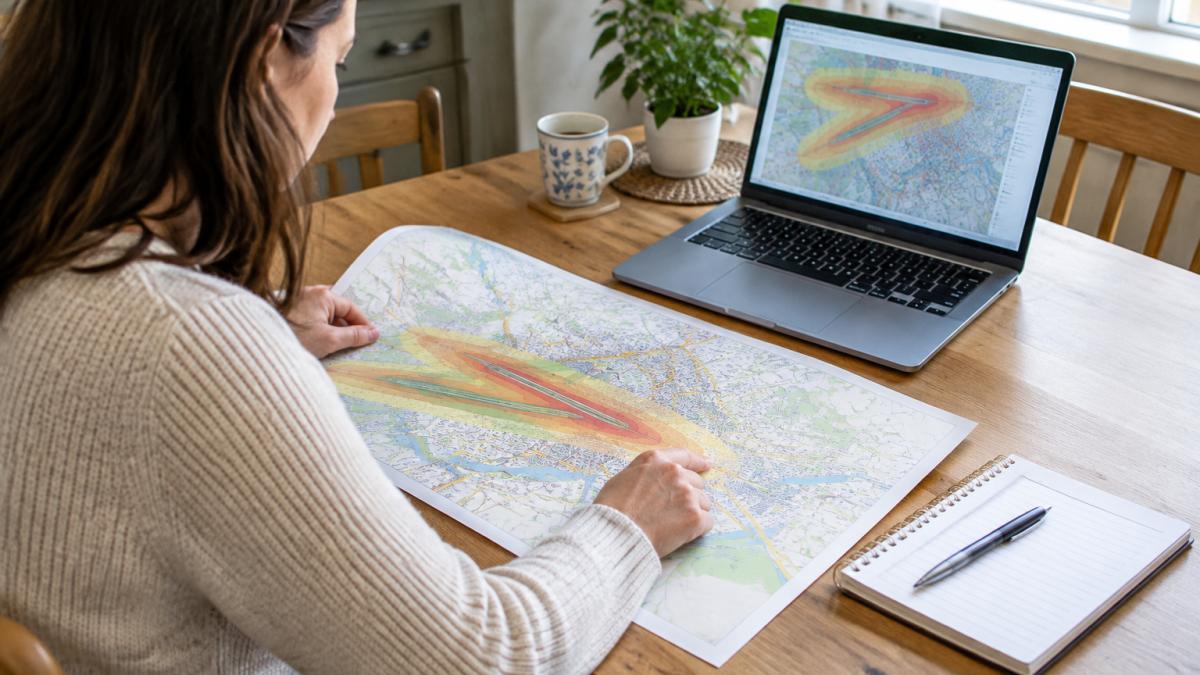
The metrics matter. Noise is usually shown using Lden (the average noise across the day, evening and night, with evening and night events weighted more heavily) and Lnight (the average night-time noise). Both are expressed in decibels, dB. A contour band might run from 55 dB Lden to 60 dB Lden, then 60 to 65, and so on. The higher the band, the more often aircraft pass overhead and the louder each event tends to be. Two postcodes inside the same band can still feel different because the number of events, the time of day and the aircraft type all vary.
To check a postcode:
- Find the airport nearest to the postcode
- Open the official noise contour layer for that airport
- Note which Lden and Lnight band the postcode sits inside, not just whether it is inside any contour
- Record the date the map was published and the version number if one is shown
- Check whether the contour is based on actual flight paths or on planned ones
Watch out: noise maps are updated when flight paths change, and an older map can understate or overstate current exposure. Always check the publication date and recheck before you offer.
A single figure can hide the pattern that matters most. A postcode might sit in a moderate Lden band but a high Lnight band if it lies under a route used by early or late departures. Read both measures together, and if the map offers separate daytime and night-time layers, compare them side by side. For a worked example, a postcode inside the 55-60 dB Lden band but outside the Lnight contour is likely to have busy daytime movements and quieter nights; the reverse pattern is the one to weigh carefully if you sleep lightly.
For the practical steps on checking a specific address and what evidence to collect, see our guide to checking a property before you offer.
How Aircraft Noise Can Affect Sleep Disturbance
Night-time noise matters most for sleep. Aircraft movements at night, even brief ones, can wake light sleepers or make it harder to fall back asleep. The effect varies from person to person, and it depends on how well the bedroom is insulated.
Local authority complaint records can also show whether noise is a recurring issue in an area. A cluster of complaints is a useful signal, though it is not a complete picture on its own.
Understanding Daytime and Night-Time Exposure
Daytime and night-time exposure are measured separately because they affect people differently. A postcode can have moderate daytime noise and much higher night-time noise, especially under a flight path used by early or late departures.
- Daytime exposure matters most for garden use and living rooms
- Night-time exposure matters most for bedrooms and sleep
- Both should be checked before deciding whether a home suits you
When you read a noise map, look for both measures. A single figure can hide the pattern that matters most to your household.
The table below sets out the two exposure measures side by side, so you can see which matters most for each part of the home.
| Exposure | Matters most for | What to look for |
|---|---|---|
| Daytime | Garden use and living rooms | Daytime noise band on the map |
| Night-time | Bedrooms and sleep | Night-time noise band on the map |
| Both | Deciding whether a home suits you | Read both measures together |
Using a Broadband Availability Checker
Broadband availability is checked postcode by postcode. Use an official or established broadband availability checker to see which speeds and technologies are offered at a specific address. Results can differ between two neighbouring properties, so always check the exact address.
Note the technology listed, such as fibre to the premises, fibre to the cabinet, or copper.
Broadband Reliability by Postcode and Why It Varies
The phrase "broadband reliability" means two different things, and the distinction matters here. In everyday use it means how reliably your internet connection works. In acoustics and aircraft engineering it means broadband noise: sound spread across a wide range of frequencies, as opposed to tonal noise concentrated at a single pitch. Most of the research on aircraft noise uses the second meaning. This section covers both, so you can tell which one applies to your concern.
Internet reliability. Reliability is not the same as availability. Two addresses can both offer fast broadband, yet one may drop out more often because of the local network, the age of the cabinet, the distance from the exchange, or contention when many households use the line at once. Aircraft noise does not directly disrupt your internet signal. Any link between the two usually comes from shared local factors, such as older infrastructure in areas that were also built up around airports. Treat any suggested link with care and check the facts for the specific street.
When comparing postcodes, look at:
- Which technologies are available at the address, such as fibre to the premises, fibre to the cabinet, or copper
- Whether fibre is offered, and how far the property is from the cabinet or exchange
Broadband noise in aircraft acoustics. In aeroacoustics, broadband noise is the hiss or roar produced by turbulent airflow, fan blades and the mixing of exhaust with the surrounding air. It is spread across many frequencies, which is why it sounds like a broad rush rather than a whistle. Tonal noise, by contrast, is a distinct whine at a specific frequency, often from fan rotation or compressor stages. Engine and airframe design aims to reduce both, and modern high-bypass engines have cut broadband noise considerably compared with older designs. This is the sense in which aircraft noise and broadband appear together in technical literature, and it is worth knowing if you are reading research reports rather than checking a connection.
For the practical steps on checking broadband at a specific address, see our guide to checking a property before you offer.
Next Steps: Checking Noise and Broadband Before You Make an Offer
Aircraft noise and broadband are two checks you can make early, before you spend money on a survey or conveyancing. Work through the noise maps, the day and night measures, and the broadband checker for the exact address.
JACKSON's Viewing Check is free and gives you an early automated view of the area, alongside flood, crime and planning data. For a fuller picture, the Instant Report costs £9, and a person-checked Area Report starts from £19. Every figure carries its source and date, so you can verify it yourself.
Remember that an area report sits alongside a survey. It is not a survey, it does not assess the condition of a building, and it does not replace a survey, a conveyancer or legal advice. Use it to decide which properties deserve a closer look.
Frequently Asked Questions
How can I check whether a property is affected by aircraft noise?
Start with official aircraft noise maps published for the airport near the property, then compare the postcode against the noise contours shown. Check the time period the map covers, since flight patterns change. Maps show average exposure, so they indicate likely patterns rather than the noise you will hear on any given night.
Where can I find official aircraft noise maps?
Airports in England and Wales publish noise contour maps and monitoring information, usually on their own websites or in planning documents. Local planning authorities may also hold noise information linked to nearby developments. Check the date of any map you use, as later flight changes can alter the picture. Your area report from JACKSON brings together the official data sources for a postcode in one place, with each figure showing its source and date.
Does aircraft noise affect broadband reliability?
Aircraft noise is an acoustic issue and does not, in itself, affect the signal carrying your broadband. The two are often confused because the word broadband is used in acoustics to describe noise across a wide range of frequencies. Broadband internet reliability depends on the network technology, distance from the exchange or cabinet, and local infrastructure. For a household question, check the postcode's broadband availability and speeds instead of relying on noise data.
How can I check broadband availability at a postcode?
Use an official broadband availability checker, which lists the technologies available at a specific address, such as fibre, full fibre or standard copper lines. Compare the speeds and providers shown for that address. Speeds can differ between neighbouring properties because of distance from the cabinet and the wiring in each building. Note the date you ran the check, because network rollouts change over time.

Short on time? Let us run the checks for you
Viewing this weekend and don't fancy an afternoon of maps? The free Foolproof Viewing Check pulls the headline tiles for any address you're looking at — no card, no sign-up.
Want the whole area read by hand and written up, checked and signed off by a real person before it reaches you? That's the Jackson pre-purchase area report. Software does the legwork so it's quick and affordable; a person makes the call so you can trust it. Reports start from £19.
Frequently asked questions
How can I check whether a property is affected by aircraft noise?
Start with official aircraft noise maps published for the airport near the property, then compare the postcode against the noise contours shown. Check the time period the map covers, since flight patterns change. Maps show average exposure, so they indicate likely patterns rather than the noise you will hear on any given night.
Where can I find official aircraft noise maps?
Airports in England and Wales publish noise contour maps and monitoring information, usually on their own websites or in planning documents. Local planning authorities may also hold noise information linked to nearby developments. Check the date of any map you use, as later flight changes can alter the picture. Your area report from JACKSON brings together the official data sources for a postcode in one place, with each figure showing its source and date.
Does aircraft noise affect broadband reliability?
Aircraft noise is an acoustic issue and does not, in itself, affect the signal carrying your broadband. The two are often confused because the word broadband is used in acoustics to describe noise across a wide range of frequencies. Broadband internet reliability depends on the network technology, distance from the exchange or cabinet, and local infrastructure. For a household question, check the postcode's broadband availability and speeds instead of relying on noise data.
How can I check broadband availability at a postcode?
Use an official broadband availability checker, which lists the technologies available at a specific address, such as fibre, full fibre or standard copper lines. Compare the speeds and providers shown for that address. Speeds can differ between neighbouring properties because of distance from the cabinet and the wiring in each building. Note the date you ran the check, because network rollouts change over time.