Best and Final Offers in England and Wales: How BAFO Works, How Sellers Score Bids, and a £29 Area Check
Practical guide to best and final offers in England and Wales: the step-by-step BAFO process, a seller scoring matrix, and a fast £29 pre-purchase area check before you bid.
In this guide
- Table of Contents
- What is a best and final offer, and why do sellers use it?
- How does the best and final offer process work?
- What should buyers include in a BAFO submission?
- How do sellers actually score competing BAFOs?
- Is a best and final offer legally binding in the UK?
- How can buyers win a BAFO without overpaying?
- What should sellers do to run a fair BAFO process?
- How a pre-purchase area report informs your BAFO before you commit
- Author perspective: rules of thumb for the final round
- Verify before you commit to your final figure
- Sources
- FAQ
- Recommended
A best and final offer (BAFO) is the last bid a buyer submits when a seller is fielding several competing offers and wants everyone to name their true ceiling in one go. In England and Wales, a BAFO is not legally binding until contracts exchange, so both sides still carry real risk after the “winner” is chosen. If you’re a buyer, submit your genuine maximum with proof you can complete it; if you’re a seller, judge offers on deliverability as much as price.
TL;DR:
- Buyers should establish their maximum willingness to pay and supporting proof before the deadline to avoid overpaying or emotional bidding.
- Sellers need to fairly evaluate offers based on deliverability factors such as funding certainty and solicitor readiness, not just price.
- A BAFO is non-binding in England and Wales until contracts are exchanged, leaving room for withdrawal or rising offers before completion.
- A quick area report helps buyers set their figure with the area’s risks known upfront, rather than discovering them at survey.
- Running a transparent process with equal deadlines and rapid post-deadline follow-up helps keep the process fair and reduces the risk of deals collapsing later.
Table of Contents
- What is a best and final offer, and why do sellers use it?
- How does the best and final offer process work?
- What should buyers include in a BAFO submission?
- How do sellers actually score competing BAFOs?
- Is a best and final offer legally binding in the UK?
- How can buyers win a BAFO without overpaying?
- What should sellers do to run a fair BAFO process?
- How a pre-purchase area report informs your BAFO before you commit
- Author perspective: rules of thumb for the final round
- Verify before you commit to your final figure
- Sources
- FAQ
What is a best and final offer, and why do sellers use it?
The term is borrowed from procurement and estate agency jargon, but in UK residential property it means one thing: the seller has told everyone bidding on the house that this round is the last, and asks for their strongest price and terms in a single sealed submission. It usually surfaces after an open house, a round of separate viewings, or a chain of competing verbal offers that the agent can no longer manage informally. Rather than fielding calls all evening as buyers try to outbid each other by a few thousand pounds at a time, the seller draws a line and asks for one clean, comparable set of offers.
It works well when a property has generated genuine competition, three or more serious buyers, strong local demand, a scarce house type. It tends to backfire in a softer market, where forcing a BAFO on lukewarm interest can spook buyers into walking rather than bidding, or where the seller ends up with offers no better than what was already on the table. As one guide to the process notes, the best and final offer format only earns its keep when there’s a genuinely competitive field to sort through.
For sellers, the trade-offs look like this:
- Forces buyers to reveal their ceiling rather than negotiating up slowly
- Draws a clear line under a chaotic multi-offer situation
- Can lose you a buyer who feels pressured and withdraws instead of bidding
- Works poorly with fewer than three genuine bidders, where it just annoys everyone
- Doesn’t guarantee the winning bid completes. Price and reliability are different things
How does the best and final offer process work?
The mechanics are simple, but the details around deadlines and disclosure decide whether the round produces a genuinely comparable set of offers or a scramble.
-
The agent notifies all interested buyers. Everyone currently in the running gets a letter, email, or call telling them the seller wants best and final offers by a stated date and time. Estate agents in England and Wales have a duty to pass on all offers to the seller, so this step should include every serious party, not just the two the agent personally favours.
-
A deadline is set, typically three to five working days out. That window gives buyers enough time to firm up their mortgage position and consult a solicitor, without letting the process drag on so long that the market moves against the seller. Guidance from Propelr’s walkthrough of the process confirms this three to five day range as the norm, and shorter windows tend to produce weaker, less-verified bids because buyers simply don’t have time to check their numbers.
-
Buyers submit in writing, usually sealed. The whole point of a best and final submission is that nobody sees what anyone else has bid until the deadline passes. Offers typically go by email or through the agent’s portal, quoting price, proposed completion date, and any conditions attached.
-
The seller (with the agent’s help) compares offers on more than price. This is where many buyers get caught out. A £10,000 higher bid with no mortgage in principle and a shaky chain often loses to a lower cash offer that can complete in six weeks.
-
The seller informs the winning buyer, and, usually, the rest. Good practice is to let unsuccessful bidders know quickly so they can move on to other properties rather than sit in limbo.
On receipt of a BAFO request, buyers should immediately check their mortgage offer is still valid, confirm their solicitor is instructed and ready to act, and decide their absolute ceiling before emotion takes over during the final 48 hours. Sellers, meanwhile, should use the window to have their solicitor pre-check the memorandum of sale process so completion can move fast once a winner is picked.
What should buyers include in a BAFO submission?
A best and final offer stands or falls on how easy it is for a seller to trust that you’ll actually get to completion. Price matters, but a scrappy, undocumented offer at a higher figure regularly loses to a lower, cleaner one.
Build your submission around three pillars: proof, terms, and presentation.
Documents to have ready:
- A mortgage Decision in Principle (DIP), or a full mortgage offer if you already have one
- Proof of funds for your deposit, a recent bank statement or savings screenshot showing the money sitting where you say it is
- Your solicitor or conveyancer’s name and confirmation they’re already instructed on your behalf
- If you’re selling to buy, evidence your own sale is progressing (memorandum of sale, buyer’s solicitor details)
Terms worth spelling out clearly:
- Deposit size and how quickly you can pay it on exchange
- Your realistic completion window, and any flexibility either way
- Any conditions attached (subject to survey, subject to mortgage valuation) stated honestly rather than buried
- Whether you’re prepared to waive minor conditions to strengthen the offer, and what you’re not willing to move on
Pro Tip: Write a short covering letter alongside the numbers. A paragraph explaining who you are, why the house suits you, and confirming your solicitor’s contact details does more to convince a seller of your seriousness than an extra few thousand pounds tacked onto an unexplained offer.
Including a clear conveyancing timeline in that letter, rather than just a completion date, gives the seller’s solicitor something concrete to check against their own schedule. Sellers who are choosing between two similar prices will often favour whichever buyer looks like the least work to get to exchange.
How do sellers actually score competing BAFOs?
Price is the easiest number to compare and the worst one to decide on alone. A seller weighing five sealed offers is really weighing five different levels of risk, and the smart approach is to score each bid across several axes rather than simply ranking by headline figure.
A practical scoring matrix looks something like this:
Weightings shift with circumstances. A seller who needs to complete fast to secure their own onward purchase might push timescale fit and chain risk higher; a seller under no time pressure might weight price more heavily and accept some chain complexity for a bigger number.
Deliverability is the variable most sellers underweight, and it’s the one that decides whether a sale actually completes. Analysis of the best and final offer process points out that a scoring approach weighting solicitor readiness and funding certainty alongside price tends to produce more reliable completions than chasing the highest number alone. Keep a short written note of why you chose the winning offer, even a few lines. If the sale falls through and you need to return to the second-place bidder, having your reasoning on record makes that conversation far easier.
Is a best and final offer legally binding in the UK?
No. In England and Wales, a best and final offer is generally not binding on either party until contracts are formally exchanged. Accepting a BAFO is a strong signal of intent, and it usually takes the property off the market, but the buyer can still withdraw and the seller can still change their mind, or accept a better offer that comes in afterwards, right up to exchange. Analysis from Redfin’s guide to the process makes the same point: verbal or written acceptance of a BAFO is not a contract, and both sides should treat the period between acceptance and exchange as genuinely fragile.
The usual causes of a BAFO collapsing afterwards are predictable: the buyer’s mortgage valuation comes in below the agreed price, a survey uncovers a costly defect, or somewhere further along the chain another sale falls through. Sellers who want extra protection sometimes ask for a lock-out agreement, a short, paid-for period where the buyer commits not to walk away without losing a fee, or push for faster solicitor engagement to shrink the window where things can go wrong. Neither buyer nor seller should treat BAFO acceptance as the finish line. It’s the start of the part of the transaction where due diligence actually matters most.
How can buyers win a BAFO without overpaying?
Decide your walk-away number before you see the deadline, not after. Negotiators call this your BATNA, your best alternative if this particular house falls through, and it’s the single most useful number you can calculate before a BAFO round because it stops the pressure of the deadline from pushing you past what the property, and your own finances, can actually justify.
Once you know your ceiling, focus on making the offer itself unimpeachable rather than just high:
- Submit a round, confident figure rather than an oddly precise one. Some buyers use escalation clauses (offering to beat the next-best bid by a fixed amount, up to a stated cap) but these can backfire if the seller shares your ceiling with other bidders, so use them cautiously.
- Offer a larger deposit if your finances allow it. It signals commitment and reduces the seller’s perceived risk.
- Only waive conditions you genuinely don’t need. Dropping a survey to look stronger is a real financial risk, not a negotiating flourish.
- Get your solicitor instructed before you submit, not after you win. A “winning” offer with no legal representation lined up looks weaker on paper than it should.
Pro Tip: If an agent tells you this is the seller’s absolute final round, test it. Ask a specific clarifying question about timescale or conditions rather than immediately re-submitting a higher number. Genuine final rounds have firm answers; tactical ones often produce vague ones or sudden flexibility.
That test matters more than it sounds. Guidance on negotiation tactics around ‘final offer’ claims points out that a stated deadline is often a pressure tool rather than a hard fact, and a short pause or a pointed question frequently reveals which one you’re dealing with.
What should sellers do to run a fair BAFO process?
Not every multiple-offer situation needs a formal BAFO round. If one buyer’s offer is clearly ahead on price and deliverability, going straight to a private negotiation with them is often faster and less likely to scare off a good buyer than forcing everyone through a sealed-bid exercise.
Where a BAFO genuinely makes sense, run it fairly:
- Give every bidder the same deadline and the same information. Nobody should get extra time or an informal heads-up on the competing numbers.
- Verify deliverability before accepting, not after. Ask for the mortgage DIP and solicitor confirmation as part of the submission itself, not as a follow-up once you’ve already said yes.
- Avoid declaring the round “final” unless you mean it. Estate agents and sellers who reopen negotiations after calling a round final damage their own credibility with future bidders, a risk flagged in analysis of why declaring an offer final can undermine a negotiation.
- Once you’ve picked a winner, move fast. A brief reservation agreement and an immediate instruction to solicitors on both sides shrinks the window where a better offer, or cold feet, can undo the deal.
How a pre-purchase area report informs your BAFO before you commit
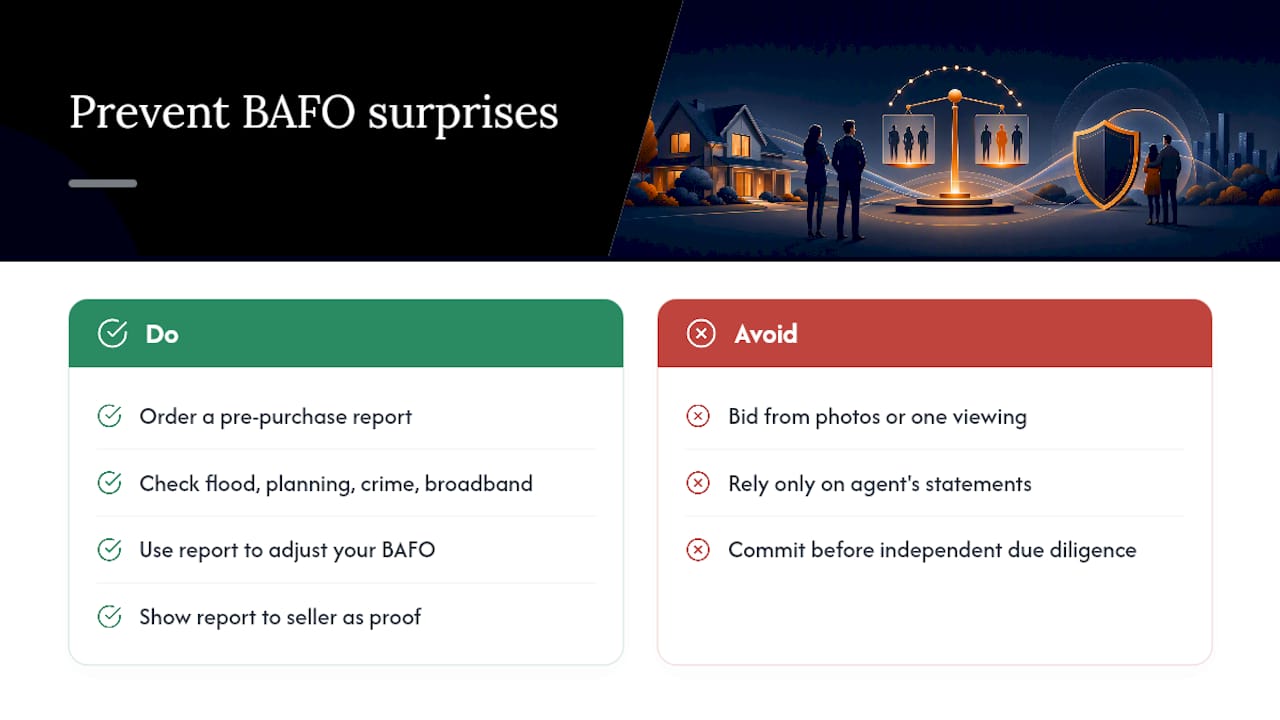
The riskiest moment in any best and final offer is the gap between deciding your number and actually knowing what you’re buying into. Most buyers price a BAFO from the listing photos, one viewing, and whatever the agent volunteers, which leaves flood risk, nearby planning applications, crime data, and nuisance sites like sewage works or busy flight paths largely unchecked until a survey much later in the process.
NoFooly’s area reports pull official data for England and Wales on flood risk and recorded floods, planning applications, crime, noise, broadband, nuisance sites and recent sold prices, and pair it with a plain-English verdict on the area; on the £29 tier a named person reads it against your brief and gives an indicative view of whether the asking price looks in line with local evidence (orientation only, not a valuation). If a report flags a flood zone the listing never mentioned, or a pending planning application next door, that’s grounds to lower your final figure, add a contingency, or walk away entirely before you’ve committed to a number you can’t take back. Fast area checks of this kind reduce the chance that something about the location surfaces after you have submitted a BAFO; the building itself is the survey’s job.
It also works in your favour with the seller. A buyer who has already checked the area’s risks can bid with fewer unknowns, though the survey still has its own job to do.
Author perspective: rules of thumb for the final round
Buyers: know your ceiling before the deadline lands, verify everything you can before you bid rather than after, and never let a “final” claim rush you into waiving a condition you actually need.
Sellers: score deliverability alongside price, don’t call a round final unless you’re prepared to hold that line, and move fast once you’ve picked a winner because momentum is the only thing protecting you from a collapsed chain.
Get a solicitor involved the moment a BAFO round starts, not once you’ve won it. The legal and survey work you’d do anyway is far more useful before you commit to a figure than after.
— Wayne
Verify before you commit to your final figure
A survey checks the building, and you should still have one. For the area around it, the other ways to check before bidding, word of mouth from neighbours or simply trusting the agent’s summary, take time or leave gaps, which is exactly the problem when a BAFO deadline gives you three to five working days to decide. Nofooly’s pre-purchase reports compress the area checking into a single document: official flood, crime, planning, nuisance and sold-price data for England and Wales, with the £9 Instant Report in minutes and the £29 person-checked report within one working day, fast enough to inform the number you actually submit, not the one you wish you’d checked first.

Reports start from £9 (person-checked from £29), cover England and Wales only, and are built for exactly this moment: when you need the area’s risks in front of you before you settle on your price, or your walk-away line. Get your report from Nofooly and submit your best and final offer knowing where you are buying.
Sources
- Best and final offers: How the process works (Propelr)
- What Is a Best and Final Offer? (Redfin)
- How to use a ‘Final Offer’ tactic to influence negotiations (The Negotiation Clubs)
This article is general information, not a substitute for advice from a qualified financial advisor. Consult a qualified financial professional about your own circumstances before acting on anything here.
FAQ
What is the best and final offer in the UK?
It’s the last, highest bid a buyer submits when a seller is fielding several competing offers and wants everyone’s strongest price and terms in one comparable round.
What is a best and final offer?
A best and final offer is the buyer’s final, strongest price and terms, submitted so the seller can compare competing bids and close the process without further back-and-forth negotiation.
Is a best and final offer legally binding?
No, not in England and Wales. A BAFO is generally non-binding until contracts exchange, meaning either party can still withdraw or renegotiate beforehand.
How do you submit a best and final offer?
Submit your offer in writing by the agent’s stated deadline, typically three to five working days, including your price, proof of funds or mortgage DIP, solicitor details, and proposed completion date.
How is a BAFO different from sealed bids or an auction?
A BAFO is a single, final negotiation round within an ordinary sale, while sealed bids follow a similar format but often with stricter procedural rules, and a property auction creates an immediately binding contract the moment the hammer falls.
Recommended
Short on time? Let us run the checks for you
Viewing this weekend and don't fancy an afternoon of maps? The free Foolproof Viewing Check pulls the headline tiles for any address you're looking at — no card, no sign-up.
Want the whole area read by hand and written up, checked and signed off by a real person before it reaches you? That's the Jackson pre-purchase area report. Software does the legwork so it's quick and affordable; a person makes the call so you can trust it. Reports start from £29.