Combined Sewer Overflows: How to Check a Postcode Before You Buy (England & Wales)
Learn how combined sewer overflows cause sewage backflow and what UK buyers must check before exchange. Order a postcode report from £9.
A combined sewer overflow discharges diluted sewage into a river or the sea during heavy rain to stop it backing up into homes. Water companies publish spill counts and hours for every monitored overflow in England (Event Duration Monitoring), so you can see how often the ones near a postcode ran last year before you offer.
In this guide
- Table of Contents
- How combined sewer systems actually work in the UK
- How sewer backups and overflows actually hit your property
- What you can do now to reduce backflow risk
- What buyers should check before exchange
- Why postcode-level data changes how buyers approach sewer risk
- Get a postcode-level check before you commit to an offer
- Sources
- FAQ
- Recommended
A combined sewer overflow (CSO) happens when heavy rain overwhelms a pipe network carrying both sewage and rainwater, forcing water companies to release the excess, untreated, into rivers or streams rather than let it back up into homes. For a buyer or homeowner, that matters in two ways: the risk of sewage backing up through your own drains during extreme weather, and the state of the local watercourse near a property you might buy. The rest of this guide covers why overflows happen, what they do to a house, how to protect yours, and what to check before you exchange.
TL;DR:
- Most sewer overflows occur during rainstorms when aging infrastructure cannot handle the volume, leading to regulated releases into watercourses rather than internal flooding.
- Internal sewage backups are caused by the same storm conditions that trigger overflows but may also result from blocked or cracked lateral drains on private property.
- Installing a backwater valve can effectively prevent sewage from backing up into your house during heavy rain events, but it does not address broken lateral pipes or groundwater infiltration issues.
- Buying a property without checking detailed drainage history risks inheriting unresolved issues, especially in areas with high water tables or flood-prone soils.
- A postcode-level flood and sewer history report can provide valuable early insight into potential drainage risks before investing in detailed surveys or making an offer.
Table of Contents
- How combined sewer systems actually work in the UK
- How sewer backups and overflows actually hit your property
- What you can do now to reduce backflow risk
- What buyers should check before exchange
- Why postcode-level data changes how buyers approach sewer risk
- Get a postcode-level check before you commit to an offer
- Sources
- FAQ
How combined sewer systems actually work in the UK
Older British towns and cities run on combined sewers, meaning your toilet waste and your roof’s rainwater share the same pipe on the way to treatment. That was a sensible design decision a century ago. It becomes a liability the moment a downpour sends more water into the network than the pipe can carry.
When that happens, water companies use a storm overflow as a pressure valve. Rather than let the pipe back up and flood streets, basements, and homes, they release the excess, a mix of rainwater and diluted sewage, into a nearby river or the sea. Water UK describes this as the deliberate design purpose of storm overflows: a controlled release, which prevents a much worse outcome indoors.
Whether a catchment copes with heavy rain depends on infrastructure that’s often decades old and on assumptions made when it was built. Southern Water’s own hydraulic modelling standard references 1-in-50-year storm events to judge whether a catchment is at risk, and plenty of areas still fall short of that benchmark. Two factors drive that shortfall:
- Ageing pipework that was never sized for today’s rainfall patterns or the extra hard surfacing (driveways, extensions, patios) that has crept across UK towns since the pipes went in.
- Groundwater infiltration, where water seeps into cracked or poorly sealed pipes from the surrounding soil, quietly eating into the spare capacity a sewer needs during a storm, a risk that University of Exeter research links to rising water tables under climate change.
Engineers at the ICE Knowledge Hub make the point plainly: rainfall gets the headlines, but infrastructure age and condition explain most of the ongoing risk. Fixing that is a network-scale job, not something any single household can do alone.
How sewer backups and overflows actually hit your property
There’s a meaningful difference between a CSO discharging into a river three streets away and sewage backing up through your own downstairs toilet. The first is an environmental problem. The second is happening in your house, right now, and it’s far more urgent for you personally.
Internal backups usually follow the same storm conditions that trigger a CSO, because the same pipe exceedance that forces water into a river can also push waste back up the pipe run into a property with nowhere else for it to go. The practical damage includes:
- Contamination of flooring, skirting boards, and soft furnishings that often can’t be salvaged
- Persistent odour that lingers long after the water is gone
- Damp and humidity that sets in behind walls and under floors
- Insurance disputes, particularly where a claim hinges on whether the cause was a public sewer failure or a private drainage fault
That distinction over fault matters enormously for cost. The lateral drain connecting your property to the public sewer is, in most cases, your responsibility as the homeowner, not the water company’s. A cracked or blocked lateral can cause a backup even during a fairly ordinary rain event, with no CSO involved at all.
Geology plays its part too. Properties on alluvial soils or near a high water table carry a higher baseline groundwater infiltration risk even where nothing has ever been recorded locally, because the soil itself is feeding water into the pipe network year round.
Pro Tip: Ask directly whether reported flooding was a “sewer flooding” incident or “surface water flooding”. They sound similar but call for different fixes, and Thames Water’s own guidance treats them as separate problems with separate solutions.
What you can do now to reduce backflow risk
You can’t control how a water company manages catchment capacity. You can control what happens between the public sewer and your front door, and that’s where the useful work sits.
- During or straight after an overflow event, stay out of contaminated water, avoid using drains until levels drop, and report the incident to your water company so it’s logged against your address.
- Photograph everything before you clean up. Insurers want dated evidence of water levels, damaged items, and the extent of contamination.
- Fit a backwater valve (also called a non-return valve) on your lateral drain. It closes automatically when water tries to flow backwards, which is exactly the mechanism Thames Water recommends as the most effective household-level protection against sewer backflow. A sump pump can help clear water that does get in, but it won’t stop sewage arriving in the first place.
- Keep gullies and gratings clear of leaves and debris, and get your private lateral checked periodically rather than waiting for a problem to announce itself.
- Bring in a drainage specialist for a CCTV survey if you’ve had any history of slow drainage or damp smells. Ask for the footage itself, not just a summary, and ask whether findings point to a repair or a full replacement.
Pro Tip: A clean CCTV run on the public sewer tells you nothing about your own lateral. The two are separate pipes with separate ownership, and only a survey of your own connection settles the question.
What buyers should check before exchange
Buying a property means inheriting whatever drainage history comes with it, recorded or not. A handful of checks at this stage save a lot of grief later.
- Ask for historic flood and sewer incident records for the property and street, not just the postcode in general terms. Water companies hold incident logs that go beyond what a standard search reveals.
- Raise specific enquiries through your conveyancer, including who’s responsible for the lateral drain, whether any sewer flooding has been recorded at the address, and whether recent repairs were made. A CON29DW drainage and water search is the usual route for this, though it sits outside anything a data report like Nofooly’s covers.
- Get a CCTV survey done independently where the history is unclear, particularly on older properties. If you’re arranging a wider site or ground investigation, a firm such as SGS Surveys can carry out topographic work that flags drainage routes and levels across a plot.
- Treat a “clean” address with caution if the geology is against it. Alluvial soils and high water tables raise groundwater infiltration risk regardless of recorded history, so an unremarkable-looking property in the wrong location can still carry real exposure.
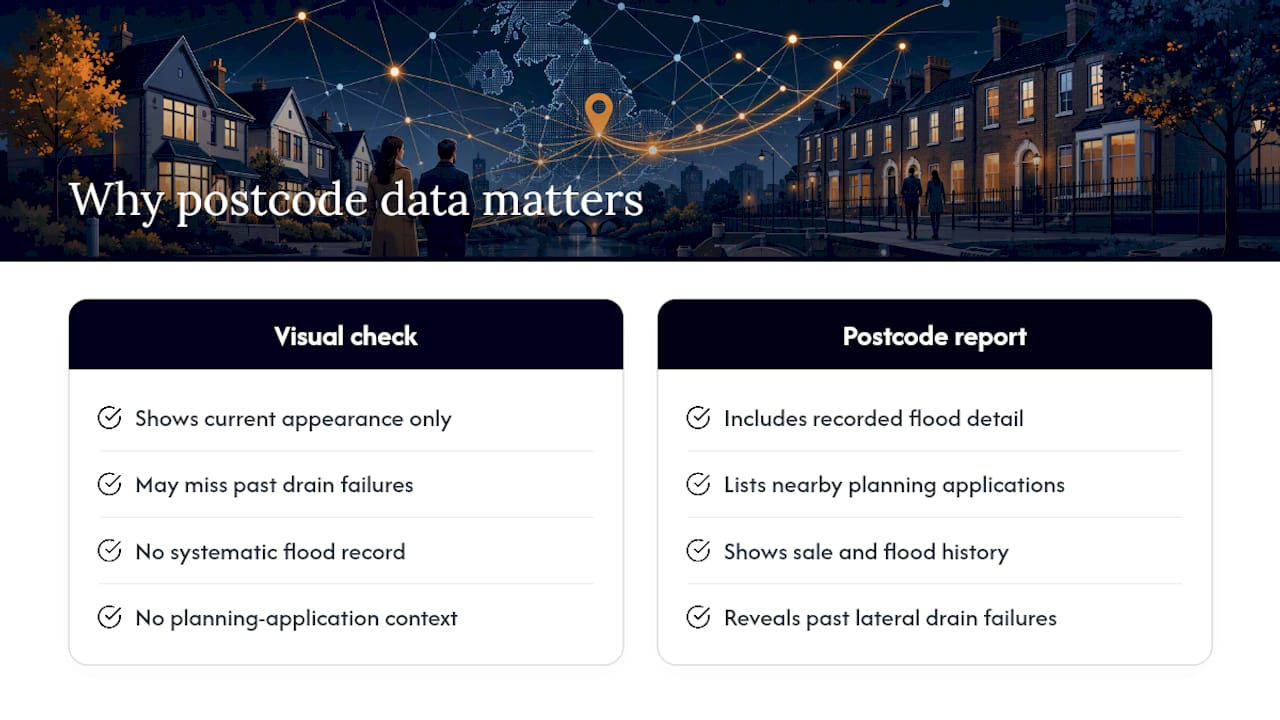
A postcode-level report that pulls together recorded floods, nearby planning applications, and sale history gives you faster context than piecing several official datasets together yourself, and it’s a sensible first filter before you commission anything more detailed.
Why postcode-level data changes how buyers approach sewer risk
Most buyers never see the gap between what a house looks like and what its drainage history actually says. A property can look pristine and still sit on a lateral drain that’s failed twice in the last decade, or in a catchment where groundwater infiltration quietly erodes capacity every winter. Nofooly exists because that gap is where expensive surprises live.
Our postcode reports for England and Wales, run by analyst Jackson, pull recorded flood detail, planning applications near the address, and sale history into one plain-English document. None of that replaces a survey or a legal search. What it does is give you enough context, fast, to know whether a property deserves closer professional scrutiny before you commit money to it.
Get a postcode-level check before you commit to an offer
You’ve read what causes overflows, what they can do to a house, and what a conveyancer’s search will and won’t tell you. What most buyers lack isn’t advice, it’s a fast, honest read on the specific postcode they’re looking at, before they spend money on surveys and searches for a property that might not be worth it.

Nofooly offers an Instant Report that provides sold prices, flood detail and recorded floods, nearby planning, and a plain-English verdict for postcodes in England & Wales. If you’re serious about a particular house, the Area Report provides a human-checked read of the evidence against your own brief and deal-breakers, with a verdict including the property’s sale history, delivered within one working day. A report comparing two shortlisted areas head to head is also available, as well as a version that adds live comparables and an indicative, orientation-only valuation.
None of these are a survey, a legal search, or financial advice, and they only cover England & Wales. What they give you is a fast, human-checked steer on whether an area’s drainage and flood history warrants a harder look. Order a report or see sample pages before your next viewing.
Sources
- Water
- BRAVA methodology 50yr flooding | Southern Water (methodology PDF)
- Evaluating groundwater infiltration risk in sewer networks under climate change | University of Exeter (article)
- Responsibilities for home owners | JD Pipes (guidance)
FAQ
What causes a combined sewer overflow?
A combined sewer overflow happens when heavy rain sends more water into a shared sewage and rainwater pipe than it can carry. Water companies release the excess into a river or the sea, a controlled measure designed to stop worse flooding inland.
Is a combined sewer overflow the same as sewer flooding in my house?
No. A CSO discharges excess water into a watercourse away from your property, while sewer flooding is sewage backing up through your own drains. The two often happen during the same storm, but they’re distinct problems that need different checks.
Who is responsible for fixing a blocked lateral drain?
The lateral drain connecting your property to the public sewer is normally your responsibility as the homeowner. A blocked or damaged lateral can cause backups even without a wider network problem.
Can a backwater valve stop sewage backing up into my home?
A correctly fitted backwater valve closes automatically when water tries to flow the wrong way, which water company guidance names as the most practical household defence against backflow. It doesn’t fix a failing lateral drain or reduce groundwater infiltration, so it works best alongside routine drain maintenance.
How can I check a property’s flood and sewer history before buying?
Ask your conveyancer to raise a CON29DW drainage and water search and request the water company’s own incident logs for the address. A postcode report from a service such as Nofooly adds fast context on recorded floods and nearby planning, though it doesn’t replace a legal search or a survey.
Does Nofooly check building condition or plumbing directly?
No. Nofooly’s reports cover area-level data, flood detail, recorded floods, planning, prices, and similar factors, not building condition, plumbing, or structural surveys. Prices start at £9 for an Instant Report, with a person-checked £29 Area Report and higher tiers available on the product page.
Recommended
Short on time? Let us run the checks for you
Viewing this weekend and don't fancy an afternoon of maps? The free Foolproof Viewing Check pulls the headline tiles for any address you're looking at — no card, no sign-up.
Want the whole area read by hand and written up, checked and signed off by a real person before it reaches you? That's the Jackson pre-purchase area report. Software does the legwork so it's quick and affordable; a person makes the call so you can trust it. Reports start from £29.