5 Checks UK Buyers Must Do to Confirm Flood Re Eligibility
Five quick checks UK buyers can run to confirm Flood Re eligibility, how to get insurer confirmation in writing, and why a pre-purchase report matters...
A home is normally within Flood Re if it is residential, in Council Tax band A to H, and was built before 1 January 2009; homes built after that date, blocks of more than three flats and business premises are excluded. Eligibility is not a quote: your insurer has to use the scheme, so get its confirmation in writing before you exchange.
In this guide
- Table of Contents
- What is Flood Re’s eligibility checklist?
- Where Flood Re usually says no
- Why passing every test still isn’t a guarantee
- How to check your property step by step
- What if your property doesn’t qualify?
- Where a Nofooly report fits: the flood picture, before the insurer conversation
- The gap between the checklist and the real decision
- Sources
- Recommended
Most owner-occupied homes that meet Flood Re’s criteria usually qualify for the scheme, but yours only benefits if your insurer actually uses the scheme. Check three things first: your home’s build date, your Council Tax band, and whether the policy is held in an individual’s name for private residential use. Pass those and you’re likely eligible, so the next step is confirming your insurer participates.
TL;DR:
- Even if a property meets Flood Re’s criteria, the insurer must agree to cede the flood risk for the scheme to apply effectively.
- Properties built after 2009 or rated outside Council Tax bands A to H are typically ineligible, with exceptions for rebuilt homes on the same footprint.
- Flood Re caps coverage at buildings of up to three residential units and excludes company-owned, business-rated, or contingency bank policies.
- Confirm participation with your insurer in writing before relying on Flood Re discounts because eligibility alone does not guarantee coverage.
- A pre-purchase area report gives you graded flood risk plus recorded historic floods for the address, in plain English — the flood half of the picture. Build date and Council Tax band you confirm yourself, and Flood Re participation you confirm with the insurer.
Table of Contents
- What is Flood Re’s eligibility checklist?
- Where Flood Re usually says no
- Why passing every test still isn’t a guarantee
- How to check your property step by step
- What if your property doesn’t qualify?
- Where a Nofooly report fits: the flood picture, before the insurer conversation
- The gap between the checklist and the real decision
- Sources
What is Flood Re’s eligibility checklist?
Flood Re works from a fixed set of criteria, and a property has to clear every one of them. Miss a single point and the scheme’s reinsurance backing isn’t available for that policy, no matter how flood prone the postcode is.
According to Flood Re’s own eligibility criteria, a qualifying property needs:
- An individual-held policy. The contract must be in a person’s name, not a company or trust, and paid as a single premium rather than split across multiple policyholders.
- Owner or family occupancy. The policyholder or their immediate family lives there, or the property sits empty pending sale or renovation.
- A domestic Council Tax band, A to H. Check this against your Council Tax bill or your local council’s website.
- Private residential use. No running a business from the address in a way that changes its rating status.
- A single unit, or a building of two or three residential units. A converted Victorian house split into two flats still counts.
- Built before 1 January 2009. Title deeds, conveyancing searches, or planning department records confirm this.
- UK mainland location, excluding the Isle of Man and Channel Islands.
There’s one useful exception buried in that list: a home demolished and rebuilt on the same footprint after 2009 can still qualify if the original structure predates the cutoff. You’ll need documentary evidence of the rebuild, typically planning permission records showing it replaced an existing dwelling rather than filled empty land. An owner-occupied semi from the 1930s, a single leasehold flat in a converted townhouse, and a three-flat Victorian conversion are all textbook qualifying cases. A new-build estate finished in 2015 is not, however flood prone the site.
Where Flood Re usually says no
The exclusions catch out more buyers than the eligibility list suggests, mostly because they hide in property types that look ordinary on paper. BIBA’s guidance on Flood Re flags the recurring problem cases:
- Bed and breakfasts paying business rates rather than Council Tax, even if the owner also lives there.
- Blocks of more than three flats, since the scheme caps buildings cover at three units.
- Company-owned homes, including many buy-to-let properties held through a limited company structure.
- Properties under contingent bank-held policies, where a lender rather than the homeowner holds the contract.
- Housing association buildings, though tenants can often still get contents-only cover even when the building itself is excluded, a nuance confirmed on Flood Re’s own FAQ.
The borderline cases worth checking twice: a landlord-let flat where the owner pays Council Tax personally rather than through a company might still qualify, while a nominally residential property that’s actually rated for business use won’t. When in doubt, check whether you’re paying Council Tax or business rates. That single distinction decides more cases than any other factor on this list.
Why passing every test still isn’t a guarantee
Flood Re isn’t an insurer, and you can’t buy a policy from it directly. It’s a reinsurance mechanism, jointly run by the government and the insurance industry and funded through a levy on household insurers. When your policy meets every criterion, your insurer has the option to pass the flood risk portion of your cover to Flood Re. They are not obliged to.
That distinction trips up a lot of buyers who assume eligibility equals automatic access. As Unda’s guide to the scheme points out, meeting the technical criteria is necessary but not sufficient. The insurer makes the final call on whether to cede that risk, and different insurers make different calls even for identical properties.
Pro Tip: Ask your insurer or broker directly, “Do you participate in Flood Re, and will you cede the flood element of my policy?” Get the answer in writing, or check that it’s stated on your policy schedule. A verbal assurance from a call centre isn’t worth much if a claim gets disputed later.
Homeowners never deal with Flood Re when they claim. Your insurer handles the claim as normal; Flood Re simply reimburses the insurer behind the scenes according to the scheme’s rules.
How to check your property step by step
Work through these five checks in order, and you’ll know your position within an hour.
- Run the Flood Re eligibility tool. It asks about property type, location, Council Tax band, build date, and occupancy, then gives a probable outcome.
- Verify your Council Tax band on your local council’s website or your latest bill. Bands A to H all qualify; anything outside that range or rated as business premises does not.
- Confirm the build date through title deeds, conveyancing searches, or planning records. Remember the demolition and rebuild exception if your home was reconstructed after 2009.
- Check your flood risk at gov.uk’s flood risk checker. Eligibility for Flood Re doesn’t mean the risk itself has vanished, and knowing the actual flood history matters for your own decision making, not just your insurance quote.
- Contact your insurer or broker with specific questions about participation and ceding, and ask for written confirmation.
Flood Re describes itself as a bridge to affordability, not a permanent fix. Over time, the scheme is designed to support a gradual shift toward risk-reflective pricing, which means today’s premium discount for eligible homes won’t necessarily hold at the same level indefinitely.
What if your property doesn’t qualify?
Ineligibility doesn’t mean you’re uninsurable, but it does mean more legwork. Tenants and leaseholders in excluded buildings can often still secure contents-only cover through Flood Re, even when the buildings element is out of reach, so check that option before assuming you’re locked out entirely.
- Speak to a specialist broker. Brokers who deal regularly with non-standard flood risk often know which insurers will quote where mainstream providers won’t.
- Invest in property-level resilience. Temporary flood barriers, airbrick covers, and non-return valves on drains can all make an insurer more willing to offer terms, or shave something off the premium.
- Factor flood history into your offer. If a survey or search flags previous flooding, that’s leverage in price negotiations, not just a red flag to walk away from.
Pro Tip: Get resilience measures assessed and quoted before you make an offer, not after exchange. Sellers are often more willing to contribute toward the cost of flood defences when it’s still part of the negotiation.
Where a Nofooly report fits: the flood picture, before the insurer conversation
Working out Flood Re eligibility from scratch means chasing Council Tax records, planning archives, and flood maps separately, then hoping they agree with each other. A pre-purchase area report pulls graded flood risk and recorded historic flood events for the address into one document, with a plain-English verdict written against your brief. It does not confirm Council Tax band, build date or Flood Re eligibility, and it is not insurance advice — it tells you what the flood picture actually is before you ask an insurer or broker what they'll do about it. NoFooly reports cover England and Wales.
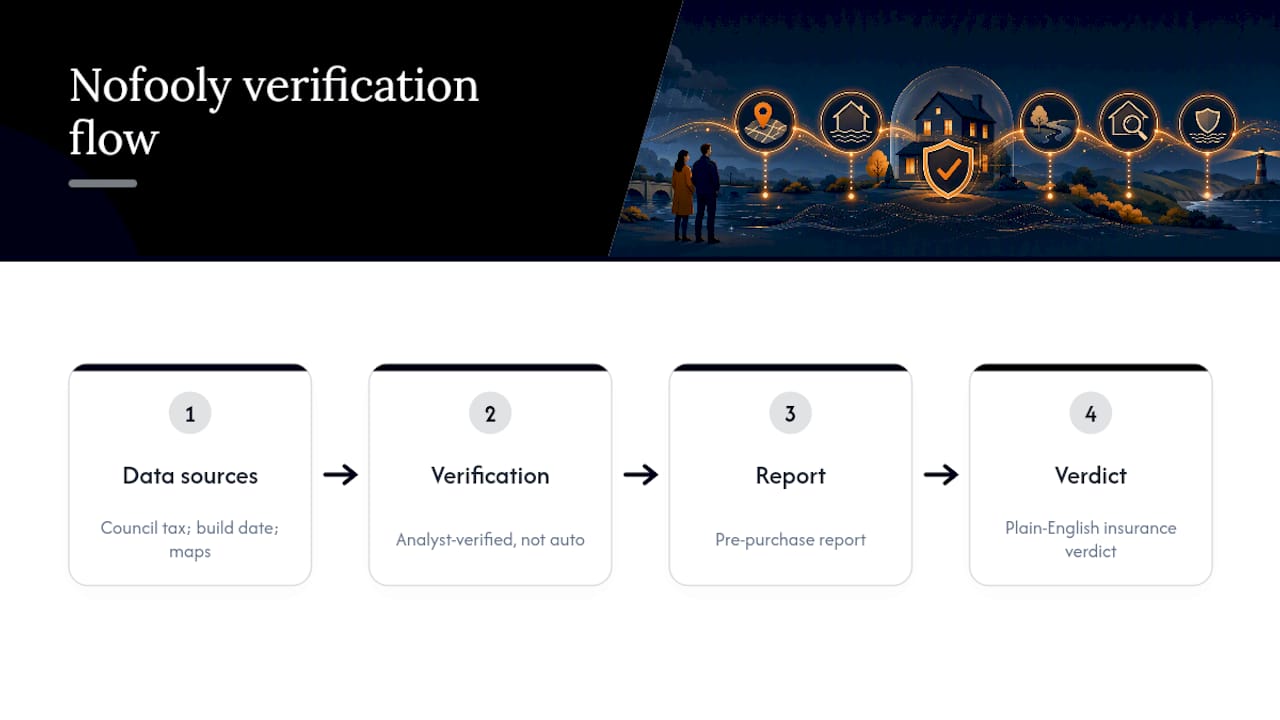
That matters most during conveyancing, when a flood risk surprise discovered late can delay or derail a purchase. Because a named analyst checks the data rather than leaving it auto-generated, you get a straight answer on the area's flood exposure rather than a raw data dump to interpret yourself. What an insurer does with that remains the insurer's call. If you’re heading toward exchange, ordering a targeted report before you commit is the sensible order of operations.
The gap between the checklist and the real decision
The eligibility criteria get treated as the whole story, and that’s where most guidance falls short. They’re a useful filter, but the insurer’s willingness to cede is the actual gatekeeper, and that part gets buried in small print rather than headline advice. A property can tick every box on Flood Re’s list and still end up with an insurer who simply doesn’t participate the way you’d hoped.
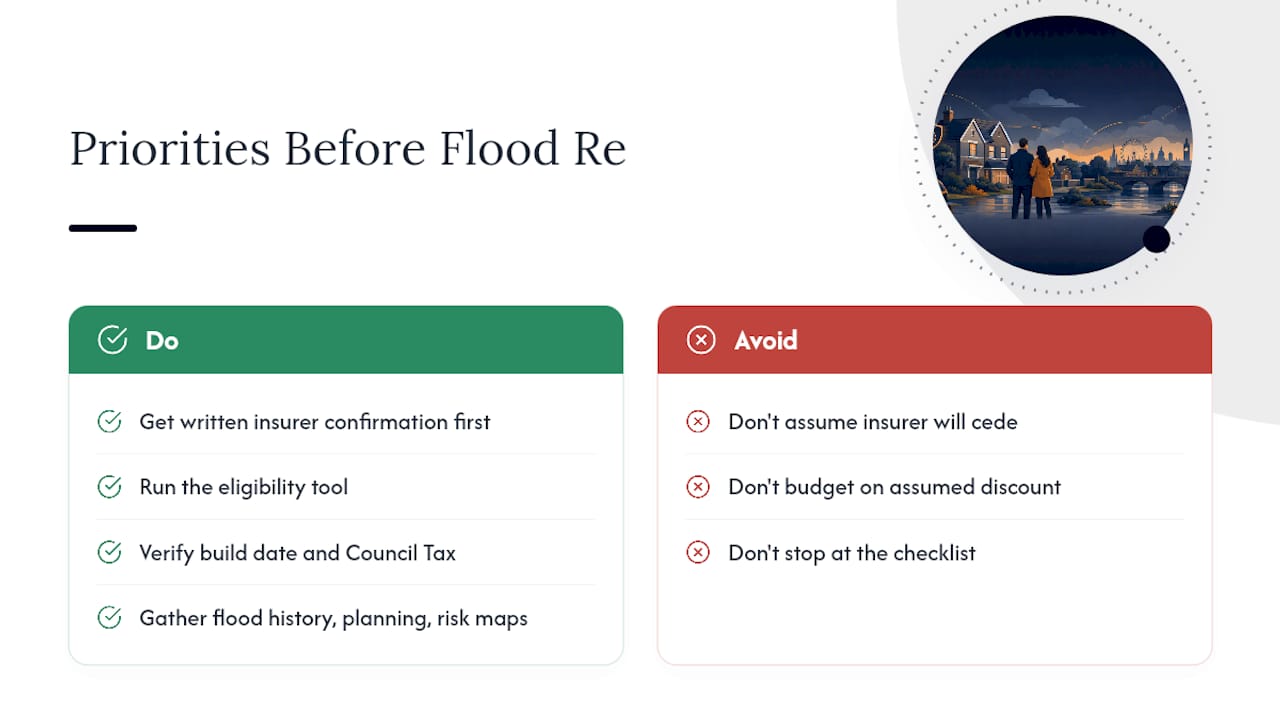
My view: buyers should prioritise the insurer conversation over the checklist itself. Run the eligibility tool, yes, but don’t stop there. Get written confirmation of participation before you factor a Flood Re discount into your budget, because a premium quote that assumes ceding and doesn’t get it can be a nasty surprise weeks into a purchase.
The build-date and Council Tax checks are things you can verify yourself with a bit of patience. Where independent verification earns its keep is pulling together flood history, planning records, and risk mapping into one coherent picture before you’re committed to a purchase, rather than discovering gaps in that picture after exchange.
— Gracie
This article is general information, not a substitute for advice from a qualified financial advisor. Consult a qualified financial professional about your own circumstances before acting on anything here.
Sources
- Gov
- Flood Re — Eligibility criteria
- BIBA — Flood Re eligibility criteria
- Unda — What is Flood Re? (guide)
Recommended
Short on time? Let us run the checks for you
Viewing this weekend and don't fancy an afternoon of maps? The free Foolproof Viewing Check pulls the headline tiles for any address you're looking at — no card, no sign-up.
Want the whole area read by hand and written up, checked and signed off by a real person before it reaches you? That's the Jackson pre-purchase area report. Software does the legwork so it's quick and affordable; a person makes the call so you can trust it. Reports start from £19.