7 ways to avoid UK gazumping: pre-purchase reports and the 2029 reforms
Learn how gazumping works across the UK, what the announced 2029 reforms will change, and seven practical steps—including pre purchase reports—to cut your risk...
Gazumping is a seller accepting a higher rival offer after accepting yours. It is legal in England & Wales because neither side is bound until contracts exchange; the announced reforms are targeted at 2029. The practical defence is speed: a mortgage agreement in principle, a solicitor instructed and searches ordered on day one.
In this guide
- Table of Contents
- What does gazumping look like in a real UK property chain?
- Is gazumping legal? The law in England & Wales, Scotland and Northern Ireland
- How common is gazumping, and what does a failed sale actually cost?
- How can you reduce the risk of being gazumped?
- What should you do if you’ve been gazumped?
- What will change under the announced reforms, and when?
- How Nofooly helps buyers move faster and offer with confidence
- An alternative worth considering before you make your offer
- Sources
- Recommended
Gazumping is when a seller accepts a higher offer from a rival buyer after already accepting yours, and in England and Wales that is currently legal because verbal acceptance carries no legal weight until contracts are exchanged. Scotland’s system makes it harder to pull off once missives are concluded. Northern Ireland largely mirrors England and Wales. The government has now announced plans to close that gap, with legally binding sales agreements targeted for introduction by 2029.
TL;DR:
- Buyers should complete surveys and legal searches promptly to minimize the risk window before contracts are exchanged, as gazumping remains legal until then.
- Scotland’s early binding “missives” reduce gazumping risk, but legal recourse for buyers remains limited across the UK until exchange.
- In high-demand areas, sellers can profitably entertain higher offers until contracts are exchanged, increasing gazumping chances, especially in lengthy chains.
- Using pre-purchase reports and securing proof of offer status can help buyers act swiftly and protect their position in a competitive market.
- Planned reforms by 2029 aim to introduce legally binding sales agreements and standardized information to significantly curb gazumping opportunities.
Table of Contents
- What does gazumping look like in a real UK property chain?
- Is gazumping legal? The law in England & Wales, Scotland and Northern Ireland
- How common is gazumping, and what does a failed sale actually cost?
- How can you reduce the risk of being gazumped?
- What should you do if you’ve been gazumped?
- What will change under the announced reforms, and when?
- How Nofooly helps buyers move faster and offer with confidence
- An alternative worth considering before you make your offer
- Sources
What does gazumping look like in a real UK property chain?
Picture this: your offer gets accepted, everyone shakes hands, and you start paying for surveys and searches, believing the sale is settled. It isn’t. Nothing is contractually fixed until contracts are exchanged, and that gap, often weeks or months, is where gazumping lives.
The typical exposure window runs through several stages:
- Offer accepted, subject to contract: the seller can still legally accept a better offer from someone else.
- Survey and mortgage valuation: you’re spending money while the property is technically still available to other buyers.
- Searches and legal enquiries with conveyancers: the slowest stage, and the one where delays invite a rival offer.
- Exchange of contracts: the point at which the deal finally becomes binding in England and Wales.
Sellers sometimes keep a listing live, or quietly entertain new interest, because they’re legally entitled to chase a higher number right up until exchange. In fast moving, high demand areas, that temptation is stronger, since a competing buyer with cash in hand or no chain can move faster than you can complete the legal process.
Is gazumping legal? The law in England & Wales, Scotland and Northern Ireland
Gazumping is legal in England and Wales, though widely regarded as poor practice. The Law of Property (Miscellaneous Provisions) Act 1989 requires contracts for the sale of land to be in writing and signed by both parties. Until that document is signed and exchanged, a verbal “yes” from a seller is not enforceable, however sincerely it was meant.
Scotland works differently. The exchange of “missives”, a formal sequence of letters between solicitors confirming terms, can create a binding obligation earlier in the process than in England and Wales. Once missives are concluded, withdrawing usually carries real legal and financial consequences for either side. That doesn’t make gazumping impossible north of the border, but it narrows the window considerably compared with the English system.
Northern Ireland’s property law tracks England and Wales fairly closely, so buyers there face broadly the same exposure: no binding contract, no protection, until exchange.
Legal recourse for a gazumped buyer is limited almost everywhere in the UK. You generally cannot force a seller to complete a sale they’ve walked away from before exchange, and claiming damages for wasted costs, such as survey or legal fees, is rarely worthwhile given the expense of pursuing it. Scotland’s earlier binding point is the main exception, and even there, disputes still end up needing a solicitor’s involvement rather than a straightforward legal fix.
How common is gazumping, and what does a failed sale actually cost?
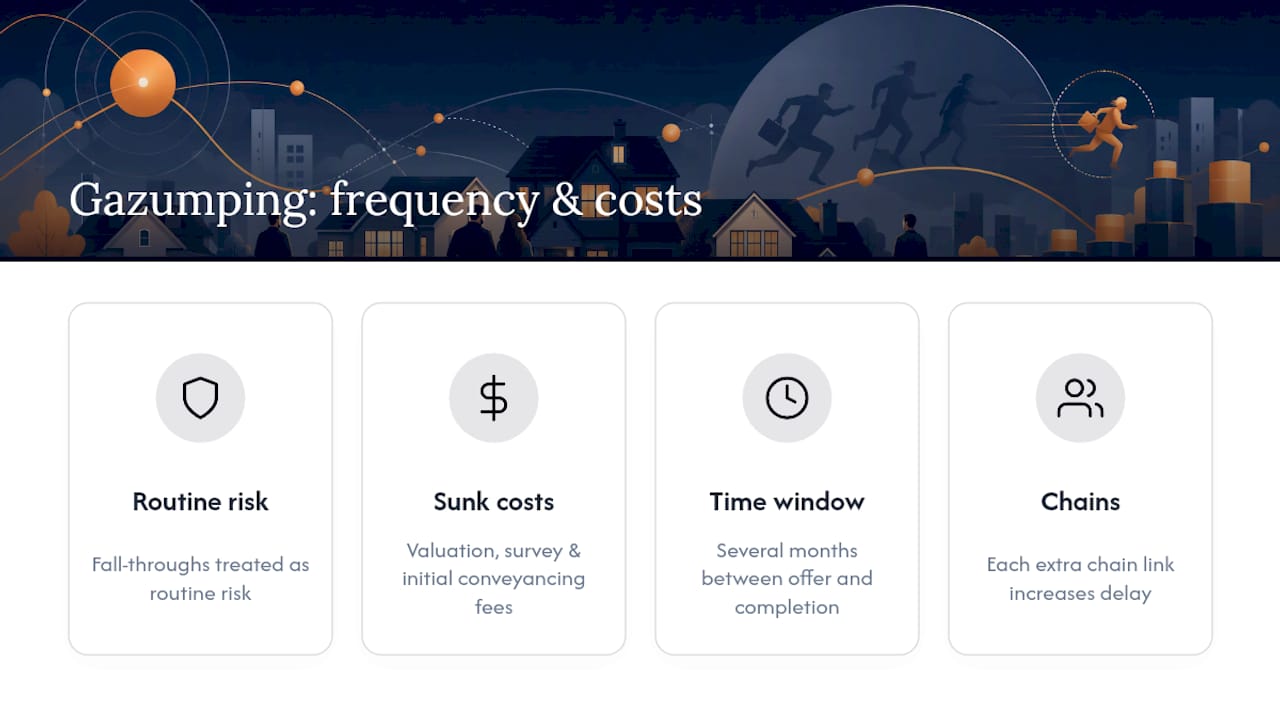
Fall-throughs are common enough that most conveyancers treat them as a routine risk rather than a rare disaster. BBC reporting on the government’s reform proposals cites data putting the average time from accepted offer to legal completion around several months, which is a long runway for a better offer to appear and for a seller’s patience, or resolve, to weaken.
The real cost of a collapsed purchase: a typical buyer who loses a sale after instructing a survey and starting conveyancing work can be several hundred pounds down before anyone talks about a higher offer elsewhere. Mortgage valuation fees, survey costs, and initial conveyancing charges are usually non-refundable once work has started, and none of it comes back if the seller changes their mind.
Chains make the exposure worse. Every extra link, another buyer, another seller, another mortgage offer awaiting approval, adds delay, and delay is exactly what gives a gazumping seller room to manoeuvre. The longer the process runs, the more time a better offer has to land on the seller’s desk.
How can you reduce the risk of being gazumped?
None of this is guaranteed to work, because the law in England, Wales and Northern Ireland simply doesn’t protect you until exchange. But you can shrink your exposure considerably with the right sequence of moves.
- Get your finances sorted before you make an offer. A mortgage in principle and proof of funds signal to the seller that you’re a low-risk buyer, not someone who might fall through in eight weeks.
- Sort your own chain first. If you’re selling too, get your sale under offer and moving before you go house hunting seriously. A seller weighing two similar offers will usually favour the buyer without a shaky chain behind them.
- Instruct your survey and conveyancer immediately. Every week saved between offer and exchange is a week the seller has less opportunity to entertain someone else.
- Ask the seller to take the property off the market and get it in writing. It’s not legally binding, but a written record, even an email, creates an audit trail and a moral commitment that most agents take seriously.
- Consider an exclusivity, or lock-out, agreement. These are legally enforceable contracts that stop the seller negotiating with anyone else for a set period, though they need proper drafting and cost money, so they suit high-value or high-competition purchases better than routine ones.
- Look at home buyers protection insurance. These policies typically reimburse survey, valuation and conveyancing fees if a sale collapses, though payouts are capped and gazumping isn’t always named as an insured event, so read the policy wording before assuming you’re covered.
- Keep the human relationship warm. Estate agents and sellers respond to buyers who stay responsive, realistic on timelines, and easy to deal with. A pragmatic completion date can matter as much as a slightly higher offer.
Pro Tip: Tell the agent in writing that your offer is “subject to contract but contingent on the property being marked as under offer.” Follow up to confirm the listing status has actually changed, and keep every email. If things go wrong, that paper trail is often the only leverage you have.
What should you do if you’ve been gazumped?
Start by confirming the facts. Speak to your solicitor and the estate agent directly rather than relying on secondhand information, since some “gazumping” stories turn out to be miscommunication rather than a genuinely higher offer.
- Decide whether to compete. You can increase your offer, but only if the property still stacks up financially at the new price. Chasing a rival offer out of frustration is how buyers end up overpaying for a house they’d never have offered that much for originally.
- Check any insurance you hold. If you took out home buyers protection cover, submit a claim for recoverable fees promptly, understanding it won’t cover the emotional cost or the time lost.
- Know when to walk away. If the numbers no longer work, or the seller has shown they’ll keep shopping your offer around, it’s often healthier to withdraw and redirect your energy to another property.
- Learn from the timeline. If slow conveyancing or a hesitant solicitor contributed to the delay that let this happen, switch to a faster-moving legal team for your next attempt.
There’s no shortcut to a legal remedy here in most cases. Your best asset going forward is speed and better information on your next purchase.
What will change under the announced reforms, and when?
The government confirmed in 2026, it intends to introduce legally binding sales agreements earlier in the property buying process, alongside standardised information “sales packs” and penalties for buyers or sellers who withdraw without good reason. BBC coverage of the announcement frames it as the biggest structural change to English and Welsh conveyancing in decades, with a target implementation date of 2029.
The likely effect, once it lands, is a much shorter window for gazumping to happen at all. Sales packs would put key legal and property information in front of buyers earlier, cutting the delay that currently stretches transactions towards six months, and conditional binding contracts would remove much of the “verbal agreement means nothing” problem that defines the current system.
None of this changes your position today, though. 2029 is years away, and until sales packs and binding agreements actually exist in practice, every buyer moving through the market now is still operating under the old rules. Speed, documentation and good information remain your only real protection.
How Nofooly helps buyers move faster and offer with confidence
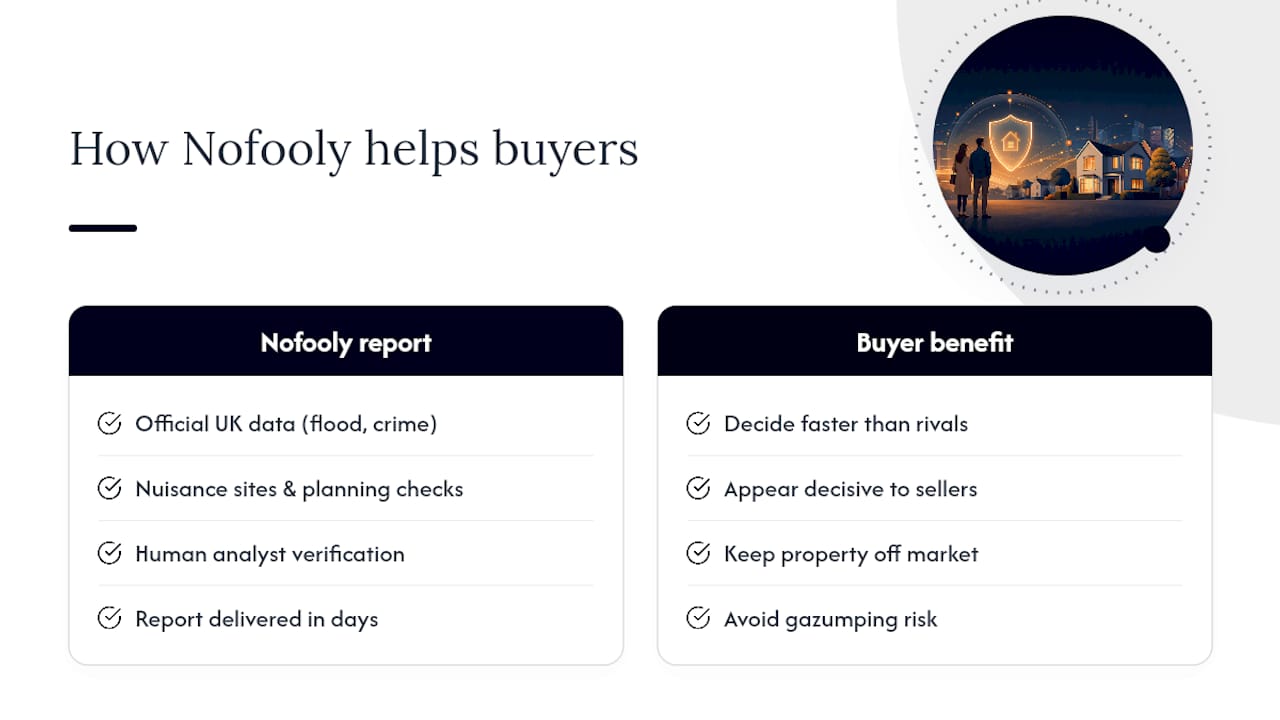
Reform is coming, but it isn’t here yet, and the fastest, most informed buyer usually wins the property, keeps the seller off the market, and avoids the whole gazumping scenario. Nofooly’s pre-purchase reports pull together official UK data on flood risk, crime, nuisance sites and planning applications, verified by a human analyst, so you can decide whether a property is worth pursuing hard within days rather than weeks.
That speed matters more than most buyers realise. A seller weighing two offers of similar size will often favour the buyer who looks decisive and well-prepared, and a clear, evidence-based verdict on the area and its risks gives you exactly that edge before you've even instructed a solicitor (an orientation-only price estimate on the Full + Live Market tier).
An alternative worth considering before you make your offer
There are other ways to gather this information yourself: chasing council planning portals, reading Environment Agency flood maps, digging through crime statistics site by site. It takes time you often don’t have when a seller is entertaining other interest.

Pre-purchase reports can do that work for you, providing a plain-English verdict — written against your brief by a named analyst — on flood risk, crime, planning and nearby nuisances like sewage works or noise, based on official UK data rather than relying solely on algorithms (with an orientation-only price estimate and live comparables on the Full + Live Market tier). Instead of spending days piecing together fragments from a dozen different sources, you get one clear document that tells you whether the area stands up to scrutiny against your brief — and, on the Full + Live Market tier, how the asking price compares with live local evidence. That’s the difference between hesitating while another buyer moves in, and making a confident offer the seller has no reason to second-guess. If you’re weighing up a property right now, start with a Nofooly pre-purchase report before you go any further with your offer. NoFooly reports currently cover England and Wales; if you're buying in Scotland or Northern Ireland, the checks and the law differ.
This article is general information, not a substitute for advice from a qualified lawyer. Consult a qualified legal professional about your own circumstances before acting on anything here.
Sources
- Plans to end gazumping with binding agreements in house sales shake-up
- What is gazumping and is it illegal? - Which?
- What is gazumping and how can I avoid it? - Zoopla
Recommended
Short on time? Let us run the checks for you
Viewing this weekend and don't fancy an afternoon of maps? The free Foolproof Viewing Check pulls the headline tiles for any address you're looking at — no card, no sign-up.
Want the whole area read by hand and written up, checked and signed off by a real person before it reaches you? That's the Jackson pre-purchase area report. Software does the legwork so it's quick and affordable; a person makes the call so you can trust it. Reports start from £19.