Start 5% Below Asking: How Much to Offer in the UK, Use Sold Prices
Set a defensible UK offer using sold-price evidence, seller signals and an AIP. Practical start points (about 5% below asking) and how to present your proof.
In this guide
- Table of Contents
- Quick rules of thumb: practical offer ranges and when to use them
- How market and seller signals should move your offer
- Use comparables and data: finding sold prices and using them well
- Money and readiness: what to prepare before you make an offer
- How to make and record your offer: what to include and how to say it
- After your offer: surveys, valuations, and renegotiating
- How an analyst-checked area report can strengthen your offer
- Negotiating as a data-driven skill
- Build your evidence dossier before you offer
- Sources
- FAQ
- Recommended
Decide your opening number from evidence, not instinct: recent sold prices for similar homes nearby, plus how ready you look as a buyer. As a working rule, start around 5% below asking in a steady market, then adjust up or down for how long the property has sat unsold, how much interest it has attracted, and your own buying position. Whatever figure you land on, remember it’s subject to contract in England & Wales and not legally binding until exchange. The sections below walk through the comparables, signals, and readiness checks that turn a guess into a defensible number.
TL;DR:
- Making an initial offer around 5% below asking price is a sensible default in a steady market, but adjustments should be based on how long the property has been listed and interest levels.
- For properties with price cuts or relistings, offers should be 5-10% below the current asking price, calibrated to the property’s market signals.
- Providing evidence of recent comparable sales and proof of financial readiness, such as a mortgage agreement in principle, strengthens your negotiating position.
- Read market signals like time on market, price reductions, and interest levels to accurately calibrate your offer and avoid over- or underbidding.
- Use area reports and comparable sales data from HM Land Registry and other sources to support your offer and guide realistic bidding, especially in fast-moving markets.
Table of Contents
- Quick rules of thumb: practical offer ranges and when to use them
- How market and seller signals should move your offer
- Use comparables and data: finding sold prices and using them well
- Money and readiness: what to prepare before you make an offer
- How to make and record your offer: what to include and how to say it
- After your offer: surveys, valuations, and renegotiating
- How an analyst-checked area report can strengthen your offer
- Negotiating as a data-driven skill
- Build your evidence dossier before you offer
- Sources
- FAQ
Quick rules of thumb: practical offer ranges and when to use them
There’s no single percentage that works everywhere, but a handful of starting points cover most situations. Which? suggests opening around 5% below asking price when a property is freshly listed and the market feels balanced, leaving room to negotiate without insulting the seller. That’s the sensible default for most first offers.
Stretch further when the listing looks tired. Sellers who’ve watched viewings dry up tend to reconsider what “reasonable” means. On the flip side, in a genuinely hot pocket of the market, going in at asking price or slightly above can be the only way to get a look-in, particularly when the agent has told you there are already two other offers on the table.
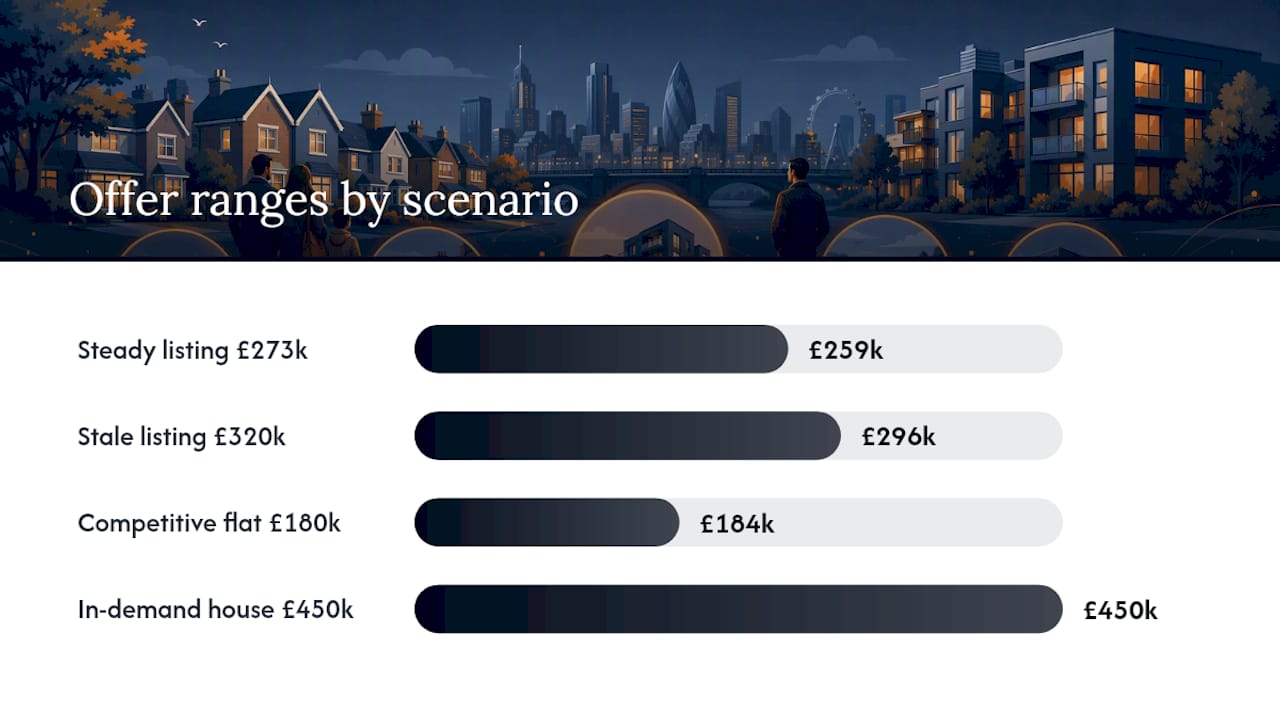
Here’s how those percentages translate into real numbers, using the current average UK house price of £273,000 as a reference point:
- A steady, well-priced listing at £273,000: opening offer around £259,000 to £260,000 (roughly 5% below), with room to move to £268,000 if the seller pushes back.
- A stale listing at £320,000 that’s had one price cut already: opening offer between £288,000 and £304,000 (a 5-10% reduction), justified by the time it’s spent unsold.
- A competitively priced flat at £180,000 in a fast-moving area: opening at asking, or even £183,000 to £185,000, if the agent hints at multiple interested parties.
- A £450,000 family house with three viewings booked in the first week: little room below asking; consider offering the full £450,000 with a strong readiness package instead of trying to shave off a percentage.
Sealed bids and “offers over” listings work differently and catch a lot of buyers out. With a sealed bid, you submit your best figure in a closed envelope (often literally, sometimes via email with a set deadline) and never see what anyone else offered. Guessing too low wastes the process; guessing too high wastes your money. The safest approach is to work out your genuine ceiling based on comparables and stick close to it, resisting the urge to round the number up “just in case.”
Pro Tip: If you’re not sure whether a market is hot or cold, ask the agent how many viewings the property has had and whether any other offers are in. A vague, deflecting answer is itself a signal that interest is thin.
How market and seller signals should move your offer
Every property carries clues about how motivated the seller actually is, and reading them properly is what separates a confident offer from a wild guess.
Time on market matters more than most buyers realise. A property listed within the past two to four weeks is “fresh,” and sellers in that window are usually still hoping for close to asking price.
Price reductions and relistings tell their own story. A seller who has already dropped the price once has effectively admitted the original figure was too high, which opens the door to negotiate from the new, lower asking price rather than the original one. A property that’s been taken off the market and relisted, sometimes with a different agent, often signals a sale that fell through, a seller under time pressure, or both. Either way, it’s worth asking directly why the relisting happened.
Level of interest is something you can and should ask about. Estate agents won’t always volunteer detail, but a direct question, “how many viewings has this had, and are there any offers on the table?”, usually gets a straight answer. If the response is vague or evasive, that’s often a sign interest is weaker than the listing suggests.
Use these signals to calibrate, not to override, the evidence from comparables:
- Fresh listing, high interest: stick close to asking, or match it.
- Fresh listing, low interest: a modest 3-5% opening offer is reasonable.
- Stale listing, price already cut once: 5-10% below the current (reduced) asking price.
- Relisted after a fall-through with no clear reason given: treat cautiously, but don’t assume desperation without asking why.
Local market context helps too. The average UK house price rose just 1.4% in the 12 months to July 2026, with growth slowing noticeably in London, the South West, and the South East. Rental data reinforces the picture: average UK private rents hit £1,400 a month in August 2026, up 3.8% annually, which suggests demand is still shifting into some areas even as sale price growth softens elsewhere. Where growth has stalled locally, lean towards the firmer end of your discount range. Where it’s still climbing, be more cautious about lowballing.
Use comparables and data: finding sold prices and using them well
The single strongest piece of evidence in any offer is what similar homes on the same street, or the next one over, actually sold for. Not what they were listed at. HM Land Registry publishes sold price data free of charge, and it’s the primary source both estate agents and solicitors treat as credible when a buyer explains their reasoning.
Getting useful comparables from that data takes a few deliberate steps:
- Search by postcode and property type rather than just the street name, since flats and houses a few doors apart can carry very different values.
- Filter for sales within the last six to twelve months wherever possible. Anything older than eighteen months in a moving market starts to lose relevance.
- Pull at least three to five comparable sales, not just the one that happens to support the number you want to offer.
- Adjust each comparable for the differences that actually affect value: extra bedrooms, a converted loft, a bigger garden, off-street parking, or a kitchen extension can each shift value by a meaningful margin.
- Note the sale date on every comparable, and weight the more recent ones more heavily if the market’s been moving quickly in either direction.
The adjustments matter as much as the raw comparable itself. A three-bed semi that sold for £310,000 eight months ago tells you very little if it had a fully refitted kitchen and the house you’re bidding on hasn’t been touched since the 1990s. Condition, size, and outdoor space are the three factors that most often explain why two seemingly similar houses on paper sold for genuinely different prices.
Where this pays off is in how you present your offer. A low bid backed by three documented sold prices reads as a considered position. The same number with no explanation reads as an insult, and agents will often say as much to the seller when passing it on.
Pro Tip: Write your comparables into the offer itself, not just into your own notes. A single line like “recent sales on [street] at £X and £Y support this figure” does more work than any amount of verbal persuasion on the phone.
Money and readiness: what to prepare before you make an offer
Sellers don’t just weigh the number. They weigh how likely you are to actually get to completion, and that calculation can matter as much as the figure itself. Propertymark’s guidance for buyers is explicit that estate agents must pass every offer to the seller, but sellers and their agents will always weigh a lower offer from a reliable buyer against a higher one from someone who looks shaky.
A mortgage agreement in principle (AIP) is the first piece of proof worth having in hand before you even view a property, never mind before you offer on one. It’s a statement from a lender confirming, in principle, how much they’d lend you based on your income and circumstances. Most banks and building societies issue these within minutes online, and having one ready signals you’ve done your homework rather than fallen in love with a house you can’t actually afford.
Sellers often prefer a slightly lower offer from a buyer who’s demonstrably reliable, cash-ready, mortgage-approved in principle, chain-free, over a higher offer from someone who looks likely to fall through.
Proof of funds matters just as much for cash buyers, and a chain-free position is genuinely valuable currency. Citizens Advice recommends working out your full affordability picture early, including stamp duty or land transaction tax, solicitor fees, survey costs, and removals, before you fix on a maximum offer figure.
Get these in order before your first offer conversation:
- A mortgage agreement in principle from your lender.
- A named solicitor or licensed conveyancer ready to act, not just “I’ll find one.”
- Proof of deposit funds, whether that’s a savings statement or a solicitor’s letter confirming funds held.
- A clear answer on your chain position: first-time buyer, sale already agreed, or still to find a buyer.
Timing flexibility is an underused card. If you can complete quickly, or match a seller’s preferred moving date exactly, that flexibility can sometimes close a price gap that a higher number alone wouldn’t have closed.
How to make and record your offer: what to include and how to say it
A phone call to the agent is fine for a first conversation, but it should never be the whole story. GOV.UK’s guidance on making an offer is clear that offers should be confirmed in writing and that you should ask the agent to formally pass it on to the seller, both for your own record and to remove any ambiguity about what was actually offered.
Your written offer should include:
- The exact figure, stated plainly rather than “around” or “roughly.”
- Any conditions, such as the offer being subject to a satisfactory survey or subject to your mortgage valuation coming in at the right level.
- Your proposed completion date, or at least a realistic timeframe.
- Evidence of readiness: your AIP, proof of funds, and confirmation of a solicitor already instructed.
- A request that the offer be passed on to the seller, in writing, so there’s a clear paper trail.
A few tactical touches genuinely help. Using a non-round figure, say £271,750 rather than a flat £270,000, tends to make an offer stand out and reads as a calculated position rather than a guess plucked from thin air. Small sweeteners can move a stuck negotiation too: offering to leave certain fittings in place, being flexible on completion date, or covering a minor cost the seller cares about can sometimes bridge a gap that pure price negotiation can’t.
Keep your actual maximum private. Once a seller or agent knows your ceiling, there’s no reason for them to accept anything lower, and you’ve lost your own room to manoeuvre.
After your offer: surveys, valuations, and renegotiating
An accepted offer is the start of the process, not the end of it, and it’s worth knowing exactly where you stand legally at this stage. Offers in England & Wales are “subject to contract” and not legally binding on either side until contracts are formally exchanged, which means either party can still walk away, and gazumping (a seller accepting a higher offer from someone else after already agreeing to yours) remains a real risk right up to exchange.
Two very different checks happen after acceptance, and confusing them causes problems for a lot of buyers:
- A mortgage valuation is done for your lender, purely to confirm the property is worth what you’re borrowing against. It’s not a condition survey and won’t flag defects.
- A homebuyer report or full building survey is done for you, and this is where structural issues, damp, roof problems, or other defects that affect value actually surface.
When a survey turns up genuine problems, that’s your evidence for renegotiating rather than walking away outright. Get a rough repair cost, ideally from a contractor quote if the issue is significant, and present that figure to the seller as the basis for a specific reduction or a retention held back at completion. A vague “the survey wasn’t great, can we have a discount” rarely lands well; a stated repair figure almost always does.
Pro Tip: If the survey reveals something serious enough to change your view of the property’s value, don’t be afraid to walk away entirely. A bad survey result is exactly the kind of contingency the “subject to contract” period exists to protect.
How an analyst-checked area report can strengthen your offer
Comparables and survey findings answer questions about the house itself. They say nothing about the postcode it sits in, and that’s a gap worth closing before you commit to a figure.
Plain-English area reports are available for any postcode in England & Wales, designed to complement your own comparable research. A free automated Viewing Check offers a quick first look. The Instant Report covers sold prices by street and property type, planning applications next door, flood detail and recorded flood history, crime data, noise and nuisance sites, broadband, and commute times, delivered as a PDF within minutes. Enhanced reports include a read by an analyst against your brief and deal-breakers, adding sale history and tenure details, and an indicative read on the asking price compared to local evidence. Some offerings compare two areas head to head or add features like orientation-only valuation indication, live comparables, negotiating position, and rent and yield figures, delivered within set timeframes.
None of this is a survey. Nofooly reports don’t check building condition, damp, subsidence, asbestos, or boiler and electrical safety, and they don’t read legal title or conveyancing searches. They’re evidence about the area, not the fabric of the house, so a proper survey and a solicitor remain essential once you’re seriously negotiating.
Negotiating as a data-driven skill
The buyers who negotiate well aren’t the ones with the sharpest instincts. They’re the ones who’ve done the comparable research, know their absolute ceiling before they walk into a viewing, and can point to a specific figure when the agent asks “why that number?” Emotion is the enemy here. The moment you’ve fallen in love with a house is exactly the moment you’re most likely to overpay for it.
My honest read, working with property data day in and day out, is that most buyers underuse the evidence that’s freely available to them. Sold price data, planning history, flood and crime records: it’s all public, and most of it sits ignored while buyers negotiate on gut feel instead. Bring in a solicitor early, treat the survey as a negotiating tool rather than a formality, and set your maximum budget in writing to yourself before you ever make an offer. The number you decide on a calm evening at your kitchen table is almost always more sensible than the one you’d decide standing in the seller’s hallway.
— Gracie C
Build your evidence dossier before you offer
There are other ways to gather the background on a postcode. You can trawl HM Land Registry manually, check the Environment Agency’s flood maps yourself, and cross-reference planning portals street by street. It takes hours, and most buyers do it patchily, if at all, under the pressure of a fast-moving sale.
Nofooly is the alternative to piecing that research together yourself: one plain-English report, checked by an analyst, for any postcode in England & Wales.

The Instant Report provides sold prices, flood and crime detail, planning applications, and a plain-English verdict shortly after ordering. An Area Report includes analysis against local evidence and buyer deal-breakers, delivered promptly. Comparison reports and more detailed market readings are also available. None of these replace a survey, conveyancing, or independent financial advice, and coverage is limited to England & Wales. If you’ve got a postcode in mind and an offer to prepare, check what a Nofooly report can tell you before you commit to a figure.
Sources
For readers who want to verify the detail directly rather than take it secondhand, these are the primary sources behind this guide:
This article is general information, not a substitute for advice from a qualified financial advisor. Consult a qualified financial professional about your own circumstances before acting on anything here.
FAQ
How much should you offer under asking price in the UK?
A common starting point is around 5% below asking in a steady market, based on Which?'s guidance.
What is a good offer on a house in the UK?
A good offer is one backed by recent sold comparables from HM Land Registry and paired with genuine buyer readiness, such as a mortgage agreement in principle and a solicitor already instructed. Sellers weigh credibility alongside price, so a slightly lower offer from a reliable buyer often beats a higher one from someone who looks likely to fall through.
Are house prices falling in 2026?
Prices aren’t falling nationally. Average UK house prices reached £273,000 in July 2026, up 1.4% over the previous 12 months, though growth has slowed noticeably in London, the South West, and the South East, which can support firmer negotiation in those regions.
Can I offer £450,000 on a £475,000 house?
Whether it’s realistic depends heavily on how long the property has been listed and how much interest it’s already attracted, so check those signals with the agent before committing to the figure.
Do I need a mortgage agreement in principle before making an offer?
You don’t strictly need one to make an offer, but Propertymark’s guidance notes that agents and sellers treat an AIP as a key sign of a serious, ready buyer. Having one in hand, along with a named solicitor, often carries as much weight with a seller as an extra few thousand pounds on the price.
Recommended
Short on time? Let us run the checks for you
Viewing this weekend and don't fancy an afternoon of maps? The free Foolproof Viewing Check pulls the headline tiles for any address you're looking at — no card, no sign-up.
Want the whole area read by hand and written up, checked and signed off by a real person before it reaches you? That's the Jackson pre-purchase area report. Software does the legwork so it's quick and affordable; a person makes the call so you can trust it. Reports start from £29.