Avoid an £11,000 Cash Trap: Modern Method of Auction in the UK
UK practical guide to the modern method of auction: spot reservation fee cash risks, meet the 56 day deadlines, and run key pre bid checks.
The modern method of auction is a conditional online auction: the winning bidder pays a non-refundable reservation fee (commonly a percentage of the price with a minimum of several thousand pounds) and then has 56 days to exchange contracts. The fee sits on top of the purchase price, so budget for it as cash and run every check before you bid, not after.
In this guide
- Table of Contents
- How the modern method of auction actually works
- What will the fees actually cost you?
- Timescales: the calendar you’re actually working to
- Weighing up the pros and cons
- A buyer’s checklist before you bid
- Getting your listing ready as a seller
- How it stacks up against traditional auctions and private treaty sales
- Reducing auction risk with a pre-purchase report
- Should you buy or sell this way?
- What the conventional advice gets wrong
- Get a pre-purchase report before you bid
- Where to read more
- Sources
- Recommended

The modern method of auction is a conditional, online property sale where the winning bidder pays a non-refundable reservation fee, then has a typical completion window following exchange. Sellers gain speed and a financially committed buyer; buyers get mortgage-friendly access to auction property but must find the reservation fee upfront, on top of their deposit, within a tight 56-day window.
TL;DR:
- Buyers must pay a non-refundable reservation fee, typically around 5% of the sale price, on acceptance of the bid, within days of winning.
- The auction process follows a strict 28/28 schedule, leaving little room for delays in mortgage processing or survey completion.
- Reservation fees are paid upfront and in addition to the deposit, creating a short-term cash gap that often catches buyers unprepared.
- Guide prices are often deliberately set low to attract interest, but the total effective cost can become higher once fees are added.
- Conducting detailed searches and risk assessments during the bidding window is critical to avoiding costly mistakes before committing financially.
Table of Contents
- How the modern method of auction actually works
- What will the fees actually cost you?
- Timescales: the calendar you’re actually working to
- Weighing up the pros and cons
- A buyer’s checklist before you bid
- Getting your listing ready as a seller
- How it stacks up against traditional auctions and private treaty sales
- Reducing auction risk with a pre-purchase report
- Should you buy or sell this way?
- What the conventional advice gets wrong
- Get a pre-purchase report before you bid
- Where to read more
- Sources
How the modern method of auction actually works
Unlike a traditional auction room with a gavel and a room full of cash buyers, the modern method runs almost entirely online, and it’s built to be accessible to anyone who could buy through an estate agent. That accessibility is the whole point. It opens auction property up to mortgage buyers who would never touch an unconditional sale, because the exchange and completion structure gives them time to actually arrange finance.
Here’s the sequence from listing to keys-in-hand:
- Listing and marketing. The property goes live on the auction platform with a guide price, photographs, and a legal pack. Viewings are arranged much like any estate agency sale, often with an open house format to create urgency and demonstrate demand.
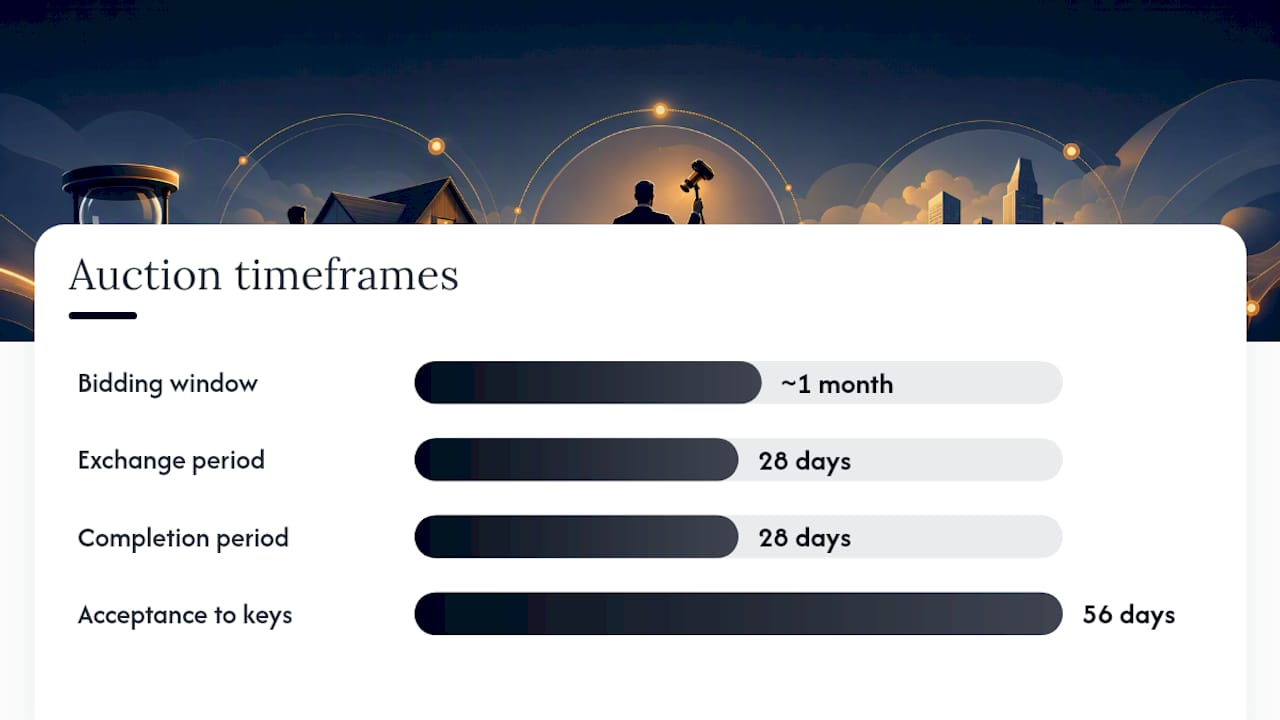
- The bidding window. Bidding typically runs for about a month, giving prospective buyers time to view the property, order searches, and speak to lenders before committing. Bids are placed online, and the highest bid wins, provided it clears the seller’s confidential reserve price.
- Winning and the reservation fee. The moment a bid is accepted, the buyer pays a reservation fee. This isn’t a normal deposit that comes off the purchase price. It’s a separate charge that secures the property and, according to the HomeOwners Alliance, is generally non-refundable if the buyer later pulls out.
- The 28/28 clock starts. From the point of reservation, the buyer typically has 28 days to exchange contracts, then a further 28 days to complete, giving a combined 56-day window from acceptance to keys.
The reservation fee mechanism is what separates this from both a traditional auction and a normal private treaty sale. It converts an accepted bid into something closer to a binding commitment immediately, rather than leaving both sides exposed to gazumping or a change of heart during a slow conveyancing process. That’s genuinely useful for sellers. For buyers, it means the financial commitment lands weeks before you’d normally be asked to pay anything under a standard house purchase.
Solicitors who deal with this process regularly point out that the 28/28 timetable, while workable, leaves little room for delay. Fosters Solicitors notes that buyers relying on a mortgage often find the schedule tight once you factor in lender processing times, valuation surveys, and local authority search turnaround. Instructing a conveyancer on the day you win the bid, not the day before exchange is due, makes a measurable difference to whether you hit the deadline.
What will the fees actually cost you?
The reservation fee is the cost buyers underestimate most, and it’s worth understanding exactly how it’s structured before you place a single bid. According to Robert Watts Estate Agents, reservation fees are commonly charged as a percentage of the sale price, subject to a minimum amount, and they sit on top of the purchase price rather than being absorbed into it.
That last point catches people out. A guide price of £200,000 with a 5% reservation fee doesn’t mean you’re paying £200,000 in total. It means you’re paying £200,000 plus a fee of roughly £10,000 (or the stated minimum, whichever is higher), plus your usual legal costs, stamp duty, and any survey fees.
Guide prices themselves deserve scrutiny. Robert Watts Estate Agents also flags that guide prices are often deliberately set low to stimulate bidding interest, which means the final effective cost, once you add the reservation fee, can end up higher than an equivalent property bought through private treaty.
| Cost item | Typical detail | Who usually pays |
|---|---|---|
| Reservation fee | Percentage of sale price, subject to a stated minimum | Buyer, paid on winning the bid |
| Legal pack | Fixed fee set by the seller or auction provider | Usually buyer, sometimes shared |
| Solicitor/conveyancing fees | Standard conveyancing rates apply | Buyer and seller separately |
| Stamp duty (where applicable) | Based on purchase price bands | Buyer |
| Survey costs | Optional, varies by survey type chosen | Buyer |
A worked example makes the cash-flow problem clear. Say a buyer wins a bid at £220,000 with a 5% reservation fee. That’s £11,000 due almost immediately, on top of whatever deposit the mortgage lender requires at completion. The HomeOwners Alliance warns that this fee is typically payable by card or bank transfer straight away and usually cannot be rolled into the mortgage advance.
That creates a genuine funding gap. Buyers who assume their mortgage will cover “the deposit” often forget the reservation fee is a separate, additional sum that has to come from savings, not from the loan. A few things to check before you bid:
- Confirm whether VAT applies to the reservation fee, since some auction providers add it and some don’t.
- Ask the auction house directly who covers the legal pack cost, since terms vary between providers.
- Work out your total cash-needed figure (reservation fee plus deposit plus legal costs) before you set your maximum bid, not after.
Timescales: the calendar you’re actually working to
The modern method follows a predictable rhythm, with listings staying open for bidding for about a month, allowing buyers time to view, search, and seek mortgage approval before committing.
Once a bid is accepted and the reservation fee paid, the 56-day structure takes over: 28 days to exchange, then another 28 days to complete. Here’s what needs to happen in each window:
- During the bidding period: arrange a mortgage in principle, book a survey provider, and start reviewing the legal pack if it’s available early.
- During the exchange window (days 1 to 28): instruct a solicitor immediately, complete local authority and environmental searches, and finalise your mortgage offer.
- During the completion window (days 29 to 56): arrange final mortgage funds release, confirm buildings insurance, and coordinate moving logistics.
Miss the exchange deadline and you risk losing the reservation fee entirely, with no automatic right to a refund. Fosters Solicitors’ briefing on the process makes the point that mortgage-dependent buyers are the ones most likely to be caught out, simply because lender processing times don’t always bend to a fixed 28-day clock. The fix is unglamorous but effective: get your Agreement in Principle sorted before you bid, not after.
Weighing up the pros and cons
For sellers, the appeal is straightforward: speed, wider reach through online marketing, and a buyer who’s already financially committed via the reservation fee. That commitment reduces the chance of a sale collapsing weeks into conveyancing, which is one of the most common frustrations in the traditional private treaty market.
The downside for sellers is perception. Some buyers associate “auction” with distressed or problem properties, even when that’s not the case, and a low guide price designed to attract bids can occasionally undersell expectations if it’s not managed carefully.
For buyers, the modern method’s biggest advantage over a traditional unconditional auction is straightforward: you can use a mortgage. The bidding process is also transparent, since you can usually see competing bid activity in real time, which takes some of the guesswork out of a private treaty negotiation.
The risks sit mostly on the buyer’s side of the ledger:
- The reservation fee is non-refundable in most cases if you fail to complete, even for reasons outside your control.
- There’s limited room to renegotiate the price after winning, even if a survey later reveals problems.
- The fee is due immediately and typically can’t be financed through your mortgage, creating a short-term cash squeeze.
- Guide prices can understate the real cost once fees are added, making budgeting harder than it looks at first glance.
A buyer’s checklist before you bid
Winning a bid feels good right up until you realise how little time you have to sort everything else out. A disciplined pre-bid routine avoids most of the expensive surprises.
- Run the searches that matter most. A title search confirms legal ownership and any restrictive covenants. A planning search flags nearby development that could affect value. A flood risk check and an environmental search cover contamination, subsidence risk, and local hazards. Skipping any of these to save time is exactly how buyers end up losing a reservation fee on a property they should never have bid on.
- Decide your survey approach early. A full structural survey takes time you may not have once the clock starts, so decide before bidding how you'll get the building looked at, and run the area checks (flood, planning, nuisance) during the bidding window so at least that half of the picture is settled before you commit.
- Map your cash position before you set a maximum bid. Add the reservation fee, deposit, legal pack cost, and estimated stamp duty together, then confirm you can access that full amount in liquid funds, since the HomeOwners Alliance is clear that reservation fees usually sit on top of the mortgage advance rather than inside it.
- Set a hard ceiling before bidding starts, and stick to it. Auction bidding creates genuine emotional pressure. Decide your absolute maximum the night before, write it down, and treat any bid above it as a different property entirely.
- Have a plan for post-win defects. If a survey turns up something serious after you’ve won, you’ll have very little leverage to renegotiate. Some buyers build a contingency figure into their maximum bid specifically to cover this risk, rather than assuming they can walk away without cost.
Pro Tip: Order your searches and risk checks during the 30 day bidding window, not after you’ve won. You cannot un-bid once the reservation fee is paid, but you can absolutely decide not to bid on a property that a flood risk or planning check has just ruled out.
Getting your listing ready as a seller
Preparation work on the seller’s side determines whether the auction actually delivers the speed and certainty it promises, or turns into a stalled listing that scares off bidders.
The legal pack is the single most important document you’ll assemble. It typically includes the title register, any restrictive covenants, planning history, and standard conditions of sale, and it needs to be ready before marketing starts, not scrambled together once bids come in. Buyers and their solicitors will judge a listing partly on how complete this pack looks.
Setting the guide price and reserve price is a balancing act. The guide price needs to be attractive enough to generate bidding activity, while the reserve, which stays confidential, protects you from selling below your actual acceptable minimum. Set the guide too high and you deter bidders before they even view; set it too low without a sensible reserve and you risk a result you regret.
A few practical points worth locking down before you list:
- Confirm with the auction provider exactly who pays for the legal pack, since this varies between platforms, as Rush Witt & Wilson points out when comparing auction house terms.
- Schedule viewings, including open house sessions, during the bidding window to maximise competitive interest.
- Get written confirmation of which auction fees you’re liable for versus which the buyer covers, so there’s no dispute after exchange.
- Brief your solicitor on the 28/28 timetable in advance so they’re not starting from scratch once a bid is accepted.
How it stacks up against traditional auctions and private treaty sales
Traditional unconditional auctions exchange contracts the moment the hammer falls, which locks in cash buyers but excludes almost anyone relying on a mortgage. The modern method solves that accessibility problem by building in the 28/28 window, but it does so by shifting financial risk onto the buyer through the reservation fee.
Private treaty, the conventional estate agency route, offers more room to negotiate price after a survey and doesn’t require an upfront non-refundable fee, but it’s slower and more vulnerable to a sale falling through late in the process.
- Choose traditional unconditional auction if: you’re a cash buyer wanting the fastest possible, most binding sale.
- Choose the modern method if: you need mortgage access but still want a financially committed counterparty and a fixed timetable.
- Choose private treaty if: you want negotiating flexibility after survey results and aren’t under time pressure to complete.
Reducing auction risk with a pre-purchase report
Every risk covered in the buyer checklist above, flood exposure, planning constraints, nuisance sites nearby, gets harder to investigate properly once the auction clock is running. That’s precisely the gap a tailored pre-purchase report is built to close.
A pre-purchase report can combine official UK datasets with human verification to flag flood risk, planning applications, and nuisance factors such as nearby sewage works or noise pollution, then deliver a plain-English verdict rather than a raw data dump.
The timing matters more in an auction context than in a normal purchase. Ordering during the bidding window, rather than after you’ve won and the fee is already paid, gives you the chance to walk away from a problem property before it costs you anything.
- On the Full + Live Market tier, use the orientation-only price estimate and live comparables to sanity-check a guide price before setting your maximum bid — an orientation figure, not a lender's valuation.
- Use it to flag flood or planning issues that a standard legal pack might not spell out clearly.
Should you buy or sell this way?
If you’re a seller who wants a fast, committed sale and can put together a clean legal pack, the modern method is a sensible route worth pursuing seriously. If you’re a mortgage-dependent buyer, it can work well too, but only if you’ve secured an Agreement in Principle and have the reservation fee sitting in accessible savings before you bid.
Either way, the next step is the same: get your paperwork and finances lined up before the clock starts, not after.
What the conventional advice gets wrong
Most guides to the modern method treat the reservation fee as a minor administrative detail. It isn’t. It’s the single biggest behavioural trap in the whole process, because it asks buyers to make a five-figure financial commitment on the same day they win a bid, often before a survey has even happened.
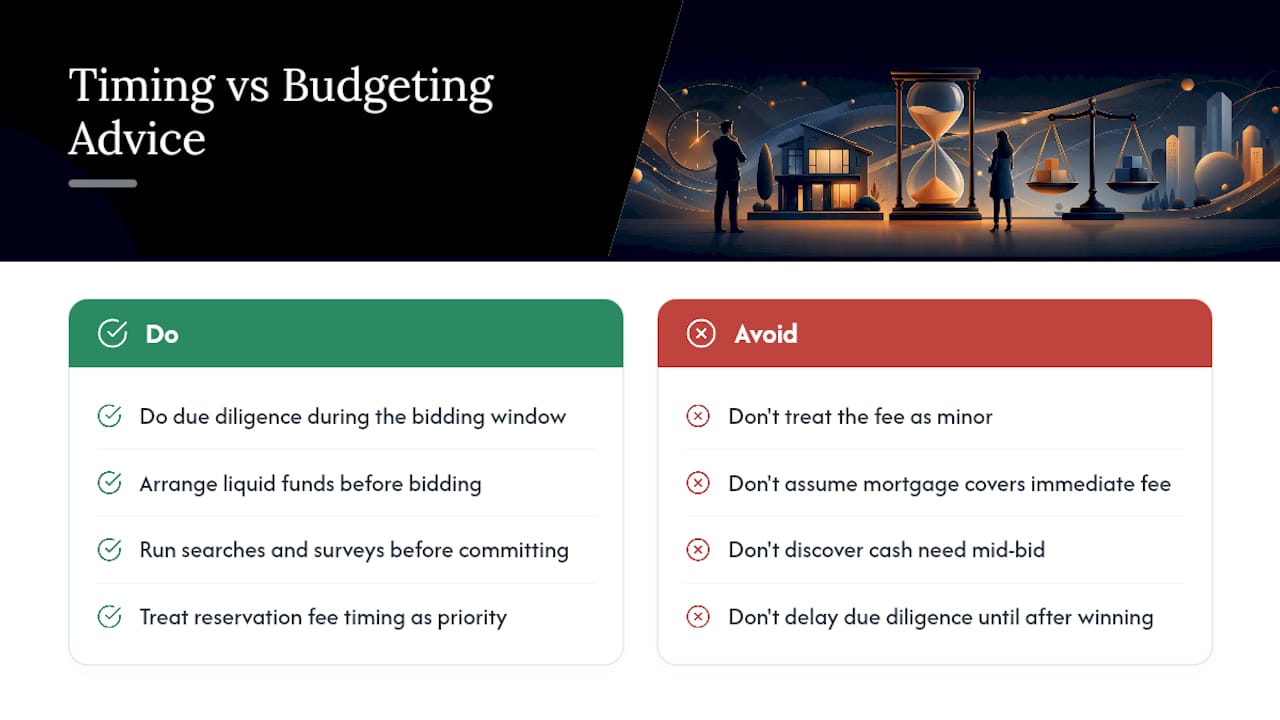
The advice that gets repeated everywhere, “budget for the fee”, misses the actual problem, which is timing, not arithmetic. Buyers know the fee exists. What catches them out is discovering, mid-bid, that the money has to be liquid and immediate, separate from mortgage funds, and gone the moment they change their mind. That’s not a budgeting failure. It’s a sequencing failure, and it happens because the guides describing this process rarely walk through the calendar in the order a real buyer experiences it.
If there’s one thing to prioritise above everything else in this guide, it’s this: do your due diligence, searches and all, during the bidding window, before you’re financially committed, not after. The 56-day clock is generous by auction standards. It’s not generous enough to fix a mistake you could have caught earlier.
— Wayne
Get a pre-purchase report before you bid
Traditional surveys tell you about the building. They don't tell you whether the area carries flood risk, whether there's a planning application next door, or (on the Full + Live Market tier) how the guide price compares with live local sales. A pre-purchase area report is not a survey and doesn't replace one — it answers the questions a survey doesn't, and it answers them quickly, before your reservation fee is at risk.

Such reports pull together official UK data on flood risk, planning applications, crime and nuisance factors like nearby sewage works or noise, then add a plain-English verdict written against your brief by a named analyst. The Full + Live Market tier adds a price estimate and live comparables — orientation only, not a mortgage valuation. Ordering one during the bidding window, rather than after you’ve won, means you can walk away from a flawed property for free instead of losing thousands on a reservation fee you can’t get back. Reports start from £9 (person-checked from £19). Order early in the bidding window so it's back before you set your maximum bid. NoFooly reports cover England and Wales. Get your pre-purchase property report before you set your maximum bid.
Where to read more
- HomeOwners Alliance: the clearest breakdown of the 56-day timetable and reservation fee rules.
- Fosters Solicitors: a legal perspective on exchange and completion pressure points.
- Robert Watts Estate Agents: detailed guidance on fee structures and guide pricing.
- Rush Witt & Wilson: a comparison of how auction provider terms vary in practice.
This article is general information, not a substitute for advice from a qualified financial advisor. Consult a qualified financial professional about your own circumstances before acting on anything here.
Sources
- Modern Method Of Auction explained - HomeOwners Alliance
- What is the modern method of auction? - Fosters Solicitors
- The ultimate guide to the Modern Method of Auction - Robert Watts Estate Agents
Recommended
Short on time? Let us run the checks for you
Viewing this weekend and don't fancy an afternoon of maps? The free Foolproof Viewing Check pulls the headline tiles for any address you're looking at — no card, no sign-up.
Want the whole area read by hand and written up, checked and signed off by a real person before it reaches you? That's the Jackson pre-purchase area report. Software does the legwork so it's quick and affordable; a person makes the call so you can trust it. Reports start from £19.