From CSVs to FOI: England & Wales noise complaint data, or a £9 report
Practical workflow for England & Wales noise complaint data: where to download CIEH and council CSVs, what fields to check, and an FOI checklist.
Start with the CIEH Noise Complaint Data Briefing for the England and Wales picture, then download individual council CSVs via the data.gov.uk index (Leeds, for example, publishes daytime and out-of-hours files). Where fields are missing, send a Freedom of Information request to the council asking for a dated CSV broken down by noise source, outcome and postcode sector.
In this guide
- Table of Contents
- Where to find the key national datasets and briefings
- Representative local datasets you can download and what they contain
- How to evaluate and prepare noise complaint datasets for analysis
- How to get missing fields or richer detail through FOI requests
- Policy and measurement caveats researchers must keep in mind
- How NoFooly uses official datasets in its area reports
- Author’s perspective on research opportunities and responsible use
- Turning raw complaint data into a plain-English verdict
- FAQ
- Sources

The best starting points for England and Wales noise complaint data are the CIEH Noise Complaint Data Briefing and the council datasets indexed on data.gov.uk. Both give national context and raw local files, but expect definition mismatches between councils and postcode reporting bias in the underlying records: these two caveats shape almost every analysis built on this data.
TL;DR:
- Noise complaint data varies across councils with inconsistent definitions and postcode accuracy, affecting reliable analysis and comparison.
- Extracting insights from council CSV files and FOI requests requires careful normalization, deduplication, and attention to reporting boundaries and update frequency.
- There is no standardised decibel threshold for nuisance in England and Wales, and councils often differentiate between requests and statutory nuisances, influencing reported volumes.
- London dominates national complaint figures, so regional differences must be considered when drawing broader conclusions or policy implications.
- Using official datasets and detailed analysis can help landlords, researchers, and policymakers better understand noise patterns and enforce or mitigate nuisance effectively.
Table of Contents
- Where to find the key national datasets and briefings
- Representative local datasets you can download and what they contain
- How to evaluate and prepare noise complaint datasets for analysis
- How to get missing fields or richer detail through FOI requests
- Policy and measurement caveats researchers must keep in mind
- How NoFooly uses official datasets in its area reports
- Author’s perspective on research opportunities and responsible use
- Turning raw complaint data into a plain-English verdict
- FAQ
- Sources
Where to find the key national datasets and briefings
Three sources anchor most serious research into UK noise complaints, and each does a different job.
- The CIEH Noise Complaint Data Briefing collects FOI-derived aggregates from councils across England and Wales and presents region-by-region tables, enforcement counts and emerging noise-source categories.
- data.gov.uk acts as a central index, linking out to council-published CSVs for daytime and out-of-hours noise nuisance, with date ranges and preview links shown before download.
- The Environmental Health Service Requests dataset on CKAN sits a level above individual council files, documenting the top-level service-request categories, including “Noise Request”, that councils use to classify incoming contacts.
None of these three is a substitute for the others. The CIEH briefing gives you the national picture and tells you which variables matter enough to appear in every council’s FOI return. The data.gov.uk index is where you actually find downloadable files, usually one CSV per council per reporting period. CKAN’s service-request taxonomy matters because it shows you how a “noise” entry gets logged before it ever becomes a statutory nuisance case, which is a distinction that trips up a lot of first-time analysts comparing councils directly.
Start with the briefing for context, then use the dataset index to pull the raw files for the councils or regions your research actually covers.
Representative local datasets you can download and what they contain
Leeds City Council’s environmental service requests dataset is a useful example because it is typical of what most councils publish. It covers daytime noise, defined as 08:00 to 18:00, and points researchers to a separate out-of-hours file hosted on Datamill North.
Across most council releases, expect these fields:
- Date received, which marks when the complaint entered the system rather than when the noise occurred.
- Postcode, almost always supplied by the reporter rather than verified, which affects spatial accuracy.
- An incident or source category code, such as music, construction, or domestic.
- Free-text notes and an outcome or enforcement action field.
- A dataset update date, which tells you how current the file actually is.
When you are stitching together several reporting periods, pull contiguous CSV slices rather than cherry-picking months, and keep the original column headers intact. Councils occasionally rename fields between releases, and silently merging differently labelled columns is one of the easiest ways to corrupt a longitudinal dataset without noticing.
How to evaluate and prepare noise complaint datasets for analysis
Before running any comparison across councils, work through a short checklist.
- Confirm whether each dataset logs a “noise request” (any contact) or a “noise nuisance” (a case meeting the statutory threshold), since conflating the two inflates apparent complaint volumes.
- Keep daytime and out-of-hours records in separate tables and note each council’s own boundary times, since Leeds uses 08:00 to 18:00 for daytime but other councils may split at 18:00 to 03:30 or similar.
- Check how complete the postcode field is and whether anonymous reports were excluded entirely, since this shapes any map you produce.
- Deduplicate repeat reports from the same address, and normalise counts by population or household figures where you have them, rather than comparing raw totals across councils of different sizes.
- Record the dataset’s update frequency and the date you pulled it, since councils refresh files on inconsistent schedules.
Pro tip: Log each council’s field dictionary in a single reference sheet before you start harmonising codes across files; retrofitting this after merging ten CSVs costs far more time than doing it first.
How to get missing fields or richer detail through FOI requests
When a published dataset lacks the breakdown your research needs, a Freedom of Information request to the relevant council usually fills the gap. Gov confirms that councils hold internal records on investigation and enforcement beyond what gets published, so a well-targeted request is often worth the wait.
A workable FOI checklist:
- Specify an exact date range and ask for the response as a CSV with field headers intact.
- Request both office-hours and out-of-hours figures, since many councils hold these separately.
- Ask for total complaint counts, a breakdown by noise source, and outcome categories such as informal resolution, abatement notice, or prosecution.
- Ask how many full-time staff work on noise cases and whether the council uses an app or remote monitoring for evidence collection.
- If full postcodes are withheld for privacy, ask for anonymised postcode sector or LSOA-level codes instead, which preserves most of the value for spatial analysis.
Policy and measurement caveats researchers must keep in mind
There is no single decibel threshold that defines a noise nuisance in England and Wales law. Defra’s noise policy statement for England treats nuisance as context-dependent, so comparing raw dB readings across councils without that context is a common analytical mistake.
- Councils must investigate potential statutory nuisance and can serve an abatement notice once satisfied a nuisance exists.
- For noise from premises, councils may delay formal action while attempting an informal resolution first, under gov.uk guidance.
- HSE’s workplace exposure values of 80 and 85 dB(A), covered in its noise at work guidance, apply to occupational safety and have no bearing on residential nuisance assessments.
London boroughs dominate the national complaint volume, with Islington, Southwark and Hackney reporting the highest counts of any authority in 2024 to 2025. That geographic concentration is one reason response rates across the full set of councils matter so much when drawing national conclusions.
How NoFooly uses official datasets in its area reports
We draw on council complaint extracts, the CIEH national briefing and central dataset indexes when we prepare the noise section of reports alongside flood, crime and planning data, read against official sources rather than guesswork.
Our reports are informational, not a survey and not legal or professional advice, and we cover England and Wales only. A noise figure in one of our reports reflects what the underlying council or national data actually says for that postcode, not a prediction about future disturbance.

Author’s perspective on research opportunities and responsible use
Noise complaint data rewards patient analysts more than ambitious ones. Spatial clustering and enforcement outcome tracking are genuinely promising, and newer categories like air source heat pumps and holiday lets are worth watching as they grow. The ethical line is simple: anonymise anything derived from reporter-supplied postcodes before publishing, since individual addresses can be inferred too easily from small samples. Our area reports draw on the same official sources, read for England and Wales postcodes only.
— Gracie C
Turning raw complaint data into a plain-English verdict
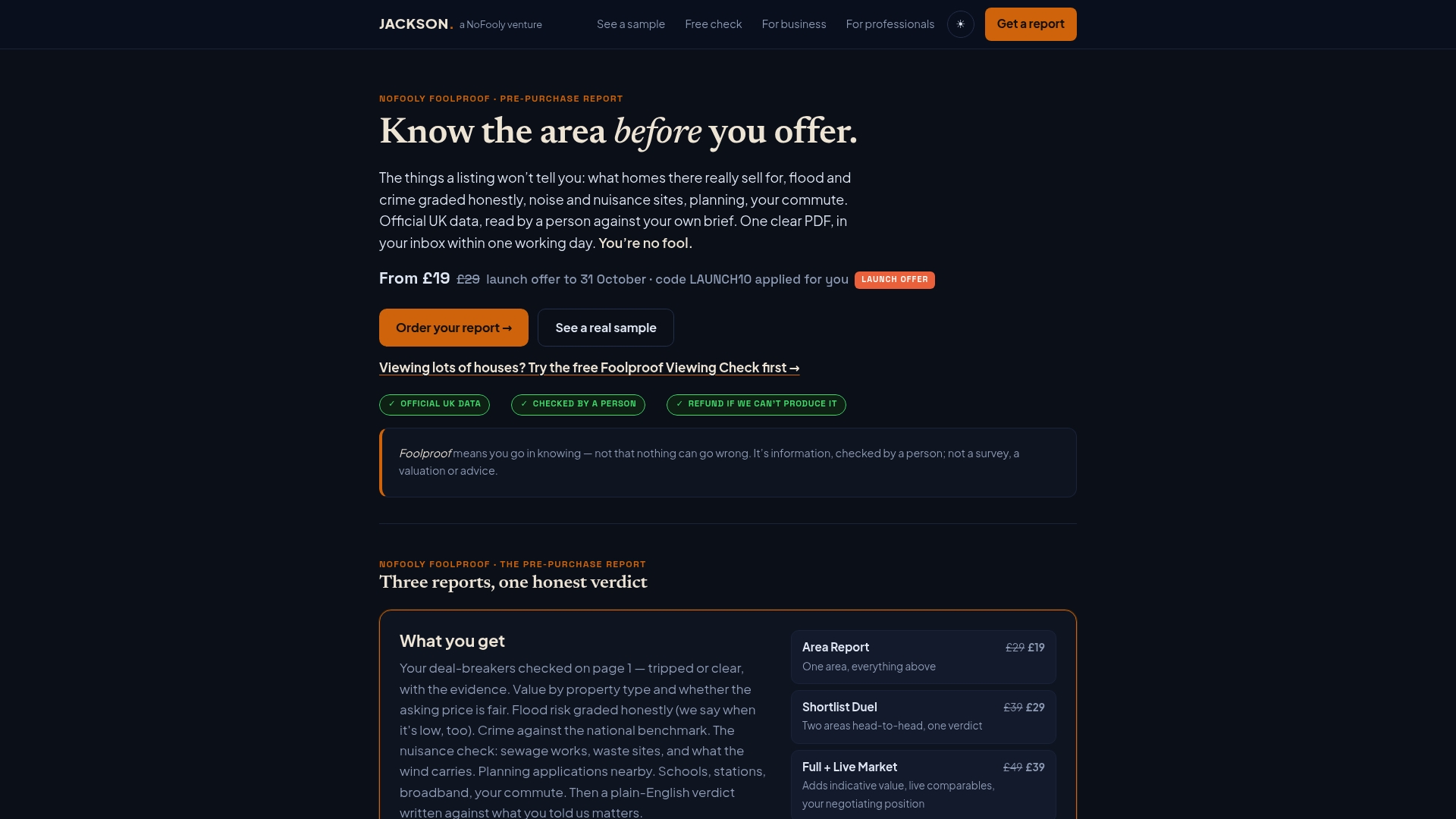
Pulling CSVs and FOI replies together takes hours most buyers do not have, which is the gap our reports fill. From £9, our Instant Report covers noise and nuisance sites for any postcode in England and Wales alongside flood, crime and planning data; from £19, a named person reads that evidence against your own brief and signs a verdict.
- Noise data drawn from official council and national sources, not estimated.
- Verdicts written for England and Wales postcodes only.
- Not a survey, and not a substitute for legal or professional advice.
If you are weighing up a flat near a known noise hotspot, check your postcode on NoFooly before you commit to a viewing. For landlords or hosts figuring out how complaint patterns might affect a let, listing a room or shared space through our proptech partner is also worth a look alongside the data.
FAQ
How many dB is too loud in the UK?
There is no single decibel figure that defines a noise nuisance in England and Wales law. Defra’s noise policy statement treats nuisance assessment as contextual, so councils weigh factors like time of day and duration rather than applying one universal threshold.
What time do you legally have to be quiet in the UK?
There is no single national quiet-hours law, but many councils define an out-of-hours period, often from around 18:00 to the early morning, for noise nuisance purposes. Leeds, for example, treats 08:00 to 18:00 as daytime and handles the remaining hours under a separate out-of-hours category.
How can I check the noise level at an address?
Published council datasets will not tell you the noise level at a specific address, since they record complaints rather than continuous measurements. You can review historic complaint volumes for an area through council open data or a national briefing like CIEH’s, or get a synthesised view for a specific postcode through a report such as our own.
My neighbour plays music all day long. What should I do?
Start by contacting your council’s environmental health team, which must investigate a potential statutory nuisance under gov.uk guidance. Councils can issue an abatement notice once satisfied a nuisance exists, though they may first try an informal resolution for noise coming from a neighbouring premises.
Sources
Short on time? Let us run the checks for you
Viewing this weekend and don't fancy an afternoon of maps? The free Foolproof Viewing Check pulls the headline tiles for any address you're looking at — no card, no sign-up.
Want the whole area read by hand and written up, checked and signed off by a real person before it reaches you? That's the Jackson pre-purchase area report. Software does the legwork so it's quick and affordable; a person makes the call so you can trust it. Reports start from £19.