When UK Buyers Should Pay Above an 'Offers Over' Price — and how to check first (reports from £9)
Understand 'offers over' for UK buyers. Learn when to bid, what checks to run, and how a pre-purchase area report (from £9) gives you evidence before you bid.
‘Offers over’ means the figure is a floor, not a target: the seller expects bids above it, and in England & Wales nothing is binding until exchange. Offer what recent sold prices for that type and street support, not what the wording implies. In Scotland the Home Report and its valuation change the picture.
In this guide
- Table of Contents
- What ‘offers over’ really means (and how it differs from guide price or OIRO)
- Why sellers and agents use ‘offers over’ pricing
- How to approach making an offer on an ‘offers over’ property
- Checks to run before you offer on an ‘offers over’ listing
- Scotland, auctions, and other special cases
- How a pre-purchase report changes the maths on an ‘offers over’ bid
- An editorial view on sensible offer strategy
- Get evidence before you bid, not after
- Sources
‘Offers over’ means the seller expects to receive offers above the figure quoted, treating it as a floor rather than a target. You can still submit a lower offer, but agents are unlikely to push it forward seriously, and there’s a separate risk: your lender’s own valuation might not stretch to match whatever figure eventually wins the property.
TL;DR:
- Setting a bid at or above the offers over price is necessary to be taken seriously, especially in competitive local markets.
- Buyers should research recent sold prices, obtain a mortgage decision in principle, and commission a survey before making high offers.
- Analyzing local benchmarks and preparing for final bidding rounds can prevent overpaying and increase chances of success.
- Checking flood risk, planning applications and nuisance factors shows whether the area supports the price being asked — evidence for your ceiling, not a valuation.
- Using reports like NoFooly’s can provide objective evidence to justify bids above the stated offer floor.
Table of Contents
- What ‘offers over’ really means (and how it differs from guide price or OIRO)
- Why sellers and agents use ‘offers over’ pricing
- How to approach making an offer on an ‘offers over’ property
- Checks to run before you offer on an ‘offers over’ listing
- Scotland, auctions, and other special cases
- How a pre-purchase report changes the maths on an ‘offers over’ bid
- An editorial view on sensible offer strategy
- Get evidence before you bid, not after
- Sources
What ‘offers over’ really means (and how it differs from guide price or OIRO)
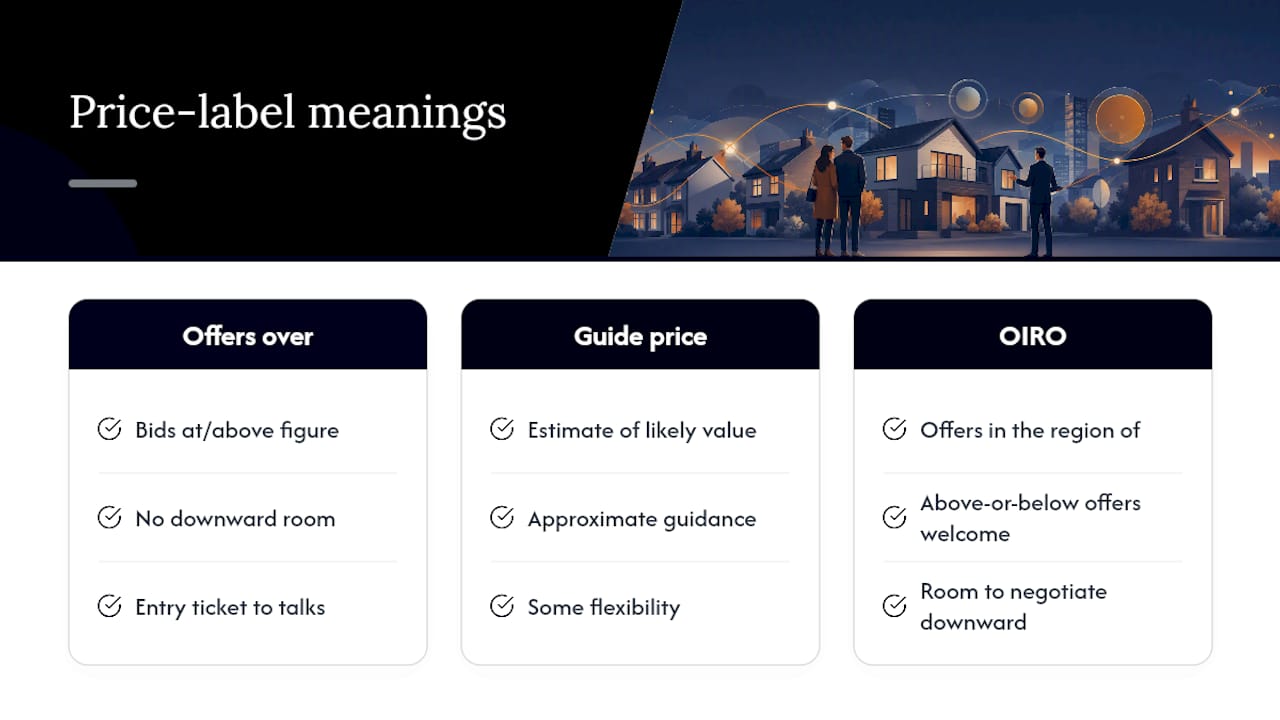
‘Offers over £250,000’ means exactly that: the seller will generally only entertain bids at or above £250,000. It’s sometimes shortened to OIEO, meaning “offers in excess of”, and both phrases carry the same message. Think of it less as a price tag and more as an entry ticket to the conversation.
That’s a different animal to a guide price, which is closer to an estimate of likely sale value, or offers in the region of (OIRO), which invites offers both above and below the stated figure. OIRO gives you room to negotiate downward without insulting anyone. Offers over doesn’t.
None of these labels are legally binding on the seller. Under English property law, no contract exists until exchange, so a seller can accept, reject, or ignore any offer regardless of how the property was marketed. Estate agents are still obliged to pass every offer to the seller, but “pass on” and “take seriously” are not the same thing, especially when your number sits well below the quoted floor.
Why sellers and agents use ‘offers over’ pricing
Agents reach for offers over when they want competition rather than a single negotiation. Setting a floor rather than a target price nudges multiple buyers into bidding against each other, which tends to push the final sale price up rather than down.
Sometimes it’s about cash flow, not clever marketing. A seller who needs a certain sum to fund their own onward purchase might set the floor at exactly that figure, non negotiable, because the maths simply doesn’t work below it.
Market context changes what the tactic actually signals. In a hot local market with genuine demand, offers over usually reflects real confidence in the property’s value. In a slower market, the same wording can be a red flag: a seller (or agent) hoping the label alone will manufacture urgency that the market itself isn’t providing. If a property’s been listed offers over for months with no sale, that’s worth noticing.
How to approach making an offer on an ‘offers over’ property
Treat the stated figure as your starting line, not your target. If you want to be taken seriously, your opening offer needs to sit at or above the quoted price, particularly in a competitive local market.
There are exceptions. If the property has been on the market for a while, or a survey or pre-purchase report has flagged issues the listing doesn’t mention, a below-the-line offer with clear reasoning attached can still get a hearing. Sellers under pressure sometimes reconsider.
Beyond that, a few practical steps make the difference between an offer that’s taken seriously and one that’s filed away:
- Set your ceiling before you start. Decide the absolute maximum you’ll pay, based on comparable sales, not on how much you want the house.
- Check recent local benchmarks. Industry guidance suggests buyers can often negotiate 5 to 15% below asking price in softer markets, but that leeway usually evaporates on offers over listings where competition is expected.
- Prepare for “best and final.” Agents often ask all interested parties to submit a final sealed bid by a set deadline. Decide your number in advance so you’re not making a rushed decision under pressure.
- Back your offer with proof. A mortgage decision in principle, proof of deposit, and a flexible completion date all make your offer look more credible than a higher but shakier one.
- Put your reasoning in writing. If you’re offering below the stated figure, a short note explaining why (condition, comparable sales, timeline) gives the agent something concrete to relay.
Pro Tip: Agents remember buyers who move fast and communicate clearly far more than buyers who simply offer the highest number. A £5,000 lower bid with a DIP already in hand can beat a higher offer that’s all talk.
Checks to run before you offer on an ‘offers over’ listing
The number on the listing tells you what the seller wants. It doesn’t tell you what the property’s actually worth, and that gap is where overpaying happens.
- Pull recent sold prices for the street or postcode using Gov and Land Registry records, not just the agent’s own comparables.
- Get a mortgage decision in principle before you offer. It confirms you’re a credible buyer and gives you a realistic borrowing ceiling.
- Commission a survey — and, alongside it, a pre-purchase area report — before you finalise a high offer. The report checks the street and the numbers; the survey checks the building. They do different jobs. Lender valuations don’t always match winning bids, and a shortfall between the two can leave you scrambling for extra deposit at the last minute.
- Check flood risk, planning applications, crime statistics, and local nuisances (a sewage works or a busy road, for instance) that rarely appear on the listing itself.
None of these checks are optional extras if you’re bidding above a stated floor. They’re the difference between a considered offer and a guess dressed up as confidence.
Scotland, auctions, and other special cases
Scotland does things differently. Sellers there commission a Home Report before marketing, which includes a formal valuation. Bidding well above that documented figure carries real risk, because your mortgage lender will often lean on the Home Report valuation rather than your winning bid.
Auctions work differently again. Guide prices at auction are usually closer to the reserve than an offers over figure, and once the hammer falls, the sale is legally binding immediately, with no cooling-off period. If you’re buying across UK jurisdictions, don’t assume the rules or terminology transfer directly from one to the other.
How a pre-purchase report changes the maths on an ‘offers over’ bid
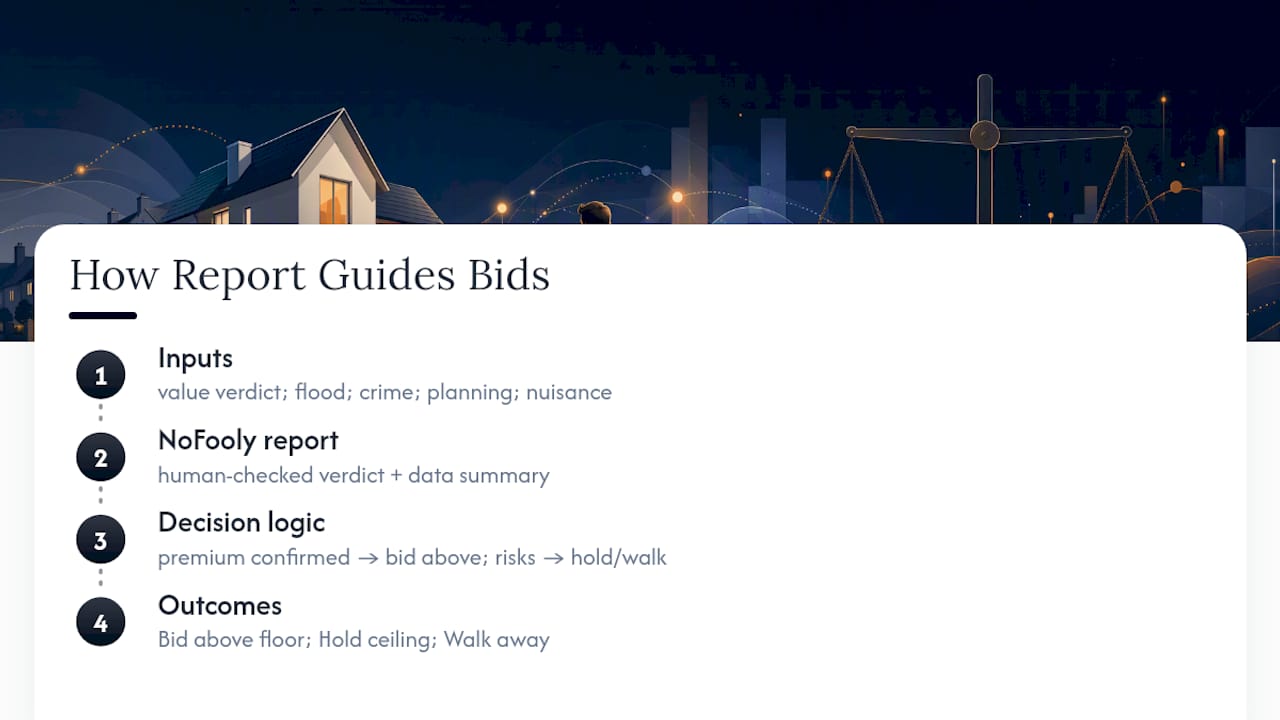
Deciding whether to bid above an offers over price becomes far less of a gamble once you can point to hard evidence rather than gut feel. That’s precisely the gap a NoFooly report is built to close.
A NoFooly report pulls together flood risk, crime, planning applications and local nuisance factors, with a plain-English verdict written against your own brief by a named analyst rather than left as a raw data dump. If you want live comparables and a negotiating-position read to judge whether a price stacks up, that's the Full + Live Market tier, priced on the order page — an orientation-only estimate, not a valuation. Used together, they show whether the area's price signals reflect genuine demand or optimism: your basis for bidding above the floor, or holding your ceiling. If it flags a flood zone or a pending planning application the listing conveniently skipped, that’s your reason to hold your ceiling, or walk away entirely.
An editorial view on sensible offer strategy
The buyers who come out ahead on offers over listings aren’t the ones who bid highest. They’re the ones who did their homework and stayed disciplined about it. Set your ceiling before you see the competition, back it with comparable sales evidence, and treat that number as fixed once the bidding gets emotional.
Bidding wars have a way of making a stretch offer feel reasonable in the moment. It rarely is. If a property’s asking price or the pace of competing bids raises genuine doubt, that’s exactly when a pre-purchase report earns its keep, giving you something firmer than adrenaline to base a decision on.
— Wayne
Get evidence before you bid, not after
An offers over listing puts pressure on you to move fast and bid high, often before you’ve had the chance to check whether that price actually stacks up. NoFooly closes that gap: NoFooly Foolproof reports start from £9 (person-checked from £19) and give you flood risk, crime, planning applications and local nuisance checks with a plain-English verdict written against your brief, from official UK data and checked by a named human analyst. The Full + Live Market tier adds an orientation-only price estimate and live comparables — not a mortgage valuation or a survey. Reports cover England and Wales. NoFooly reports currently cover England and Wales. In Scotland the Home Report and its valuation change the picture — the checks and the law differ.

A report like this is not a survey or mortgage advice. It sits alongside them, giving you the context to know whether a stated floor reflects genuine local demand or optimistic pricing, before you commit to a figure you can’t easily walk back. If you’re weighing up whether to bid above an offers over price, order a report for the property first and make your offer with actual evidence behind it.
This article is general information, not a substitute for advice from a qualified financial advisor. Consult a qualified financial professional about your own circumstances before acting on anything here.
Sources
Short on time? Let us run the checks for you
Viewing this weekend and don't fancy an afternoon of maps? The free Foolproof Viewing Check pulls the headline tiles for any address you're looking at — no card, no sign-up.
Want the whole area read by hand and written up, checked and signed off by a real person before it reaches you? That's the Jackson pre-purchase area report. Software does the legwork so it's quick and affordable; a person makes the call so you can trust it. Reports start from £19.