Planning use classes: What England & Wales buyers must check in 2026
What planning use classes mean for buyers in England & Wales in 2026: Class E, Class MA conversions, Article 4 directions and how to check lawful use.
Check the property's lawful use class on the local planning register and the original decision notice, read any conditions that narrow it, confirm whether an Article 4 direction has withdrawn permitted development rights, and check whether any prior approval (for example under Class MA) was actually granted. Note the Class E system applies in England; Wales still uses the older use classes.
In this guide
- Table of Contents
- What the current use classes are
- The 2020 reforms and why Class E matters
- Permitted development and Class MA: commercial to residential
- Article 4 directions and local limits on permitted development
- How to check a property’s lawful use
- Practical checklist for buyers, landlords and advisers
- Timescales, procedure and what to budget for
- Impact of planning reforms since 2020
- Temporary and flexible use under current rules
- Sui generis uses and how they interact with use classes
- Restrictions and conditions attached to specific use class changes
- Case studies: how use class changes play out in practice
- Author perspective: practical takeaway for 2026 transactions
- How a NoFooly area report helps with planning checks
- FAQ
- Sources

Use classes group property by lawful function, and moving between two uses in the same class normally does not need planning permission. The highest-impact change to know about is the Class E to Class C3 route, which lets some shops and offices become homes under permitted development. Before you buy or convert anything, check the property’s entry on the local planning register and confirm whether an Article 4 direction removes that right locally.
TL;DR:
- Check existing Article 4 directions and planning conditions, as they can restrict permitted development rights even if the property’s use class allows it.
- Confirm the property’s current use class by reviewing the local planning register and the original decision notice, paying special attention to any restrictions or conditions.
- Be aware that conversions under Class MA depend on meeting specific eligibility criteria, including continuous use and vacancy tests, and require prior approval for issues like flood risk or noise.
- Understand that some uses, such as pubs or large houses in multiple occupation, are sui generis and require full planning permission for changes even within the same use class.
- Recognise that local authorities may withdraw permitted rights via Article 4 directions, and always verify these restrictions before proceeding with property use changes.
Table of Contents
- What the current use classes are
- The 2020 reforms and why Class E matters
- Permitted development and Class MA: commercial to residential
- Article 4 directions and local limits on permitted development
- How to check a property’s lawful use
- Practical checklist for buyers, landlords and advisers
- Timescales, procedure and what to budget for
- Impact of planning reforms since 2020
- Temporary and flexible use under current rules
- Sui generis uses and how they interact with use classes
- Restrictions and conditions attached to specific use class changes
- Case studies: how use class changes play out in practice
- Author perspective: practical takeaway for 2026 transactions
- How a NoFooly area report helps with planning checks
- FAQ
- Sources
What the current use classes are
Planning use classes sort buildings by what they are lawfully used for, under the Use Classes Order 1987 as amended. Class E covers most commercial, business and service uses: shops, cafés, offices, gyms, and medical clinics. Class F1 covers education and non-residential institutions such as schools and places of worship, while F2 covers local community uses like village halls and small shops serving a local need. The C classes cover residential uses: C3 is standard dwellinghouses, C5 is secure residential institutions, and C6 covers houses in multiple occupation above a certain size. The B classes cover industrial premises: general industrial and storage or distribution uses that sit outside Class E.
Some uses do not fit any class at all. These are sui generis, meaning “of its own kind”, and include pubs, cinemas, theatres, drive-through restaurants, and betting shops. According to Planning Portal guidance, moving between two uses within the same class usually does not amount to development and so usually does not need planning permission, though a property’s own conditions can still restrict that movement.
The 2020 reforms and why Class E matters
The Town and Country Planning (Use Classes) (Amendment) (England) Regulations 2020 rewrote the use classes system in England from 1 September 2020; Wales kept the earlier use classes, so the Class E and Class MA routes described here apply in England only. It merged what used to be separate shop, office, and light industrial-service classes into the single Class E, and split out education and community uses into new Classes F1 and F2. A shop that used to sit in its own retail class can now sit alongside a café, a gym, a medical practice, and an office, all within Class E, which means an owner can swap between those uses without applying for permission.
That flexibility comes with caveats. Older planning permissions, leases, and conditions drafted before September 2020 often still refer to the pre-2020 classes by name, and those references do not automatically update. A condition tying a unit to “A1 retail use only” still has legal force even though A1 no longer formally exists, so always read the original decision notice rather than assuming the modern Class E label overrides it.
Permitted development and Class MA: commercial to residential
Class MA of the General Permitted Development Order allows certain Class E buildings to become Class C3 dwellings without a full planning application, subject to prior approval. Eligibility depends on the building having been in a qualifying use for a continuous period, staying under a floorspace cap, and meeting vacancy tests that vary by circumstance, so the exact conditions are worth checking against the current legislation for any specific building.
Prior approval is not a formality. The local planning authority assesses transport and highways impacts, contamination risk, flood risk, noise from nearby uses, and whether the proposed homes meet adequate natural light and internal space standards. Developers must complete the works within a set timeframe once prior approval is granted. Conversions are commonly refused or delayed over flood risk in unsuitable locations or noise from an adjoining commercial use, so anyone buying a converted or convertible unit should check whether prior approval was actually granted, and on what conditions, rather than assuming the Class MA route was available and clean.
Article 4 directions and local limits on permitted development
Article 4 of the GPDO lets the Secretary of State or a local planning authority withdraw specific permitted development rights across a defined area. Authorities use this power where national policy would otherwise let too much change happen without local scrutiny, often to protect office supply or a town centre’s retail core.
A concrete example: the Norwich Article 4 modification disapplied Class MA for a number of specified office sites, after concerns that uncontrolled conversion to flats would erode core office space the city wanted to keep. The direction did not touch every office in Norwich, only the sites named in the notice.
Because these directions are targeted rather than blanket, you cannot assume your street is covered or exempt. Check the local authority’s own Article 4 register and the property’s planning history before relying on what would otherwise be a permitted right.
How to check a property’s lawful use
Start with the local planning authority’s online planning register and search the address for its application history. This shows past permissions, refusals, and any conditions still attached to the site.
Next, check whether an Article 4 direction applies, since this can remove a permitted development right that would otherwise let a buyer or seller change use without applying. Then look for outstanding prior approvals or enforcement notices: an enforcement notice means the authority has flagged the current use as unlawful, which can be a serious problem for a purchase.
Where the lawful use is genuinely unclear, such as a mixed-use history or a use that has run quietly for years without formal permission, you can apply for a Lawful Development Certificate (LDC). An LDC for an existing use needs clear evidence of continuous use, such as business rates records, dated photographs, utility bills, or lease documents; an LDC for a proposed use needs evidence that the plan would be lawful if carried out. Dorset Council’s guidance recommends checking the register and considering an LDC before committing to a purchase or lease, precisely because ambiguity here creates real enforcement risk later. Raise anything unresolved with the planning authority before you exchange contracts, not after.

Practical checklist for buyers, landlords and advisers
Use this as a quick reference when you are assessing planning risk on a property.
- Confirm the property’s current use class from the planning register or the decision notice.
- Search the full planning history for conditions, refusals, and appeals.
- Check whether an Article 4 direction applies to the site.
- Check for prior approval records if the building has been, or might be, converted under permitted development.
- Consider a Lawful Development Certificate if the use is ambiguous.
- Read the conditions on the planning decision notice in full, not just the headline permission.
- Budget realistic time and fees for any application or prior approval you might need.
Two red flags deserve immediate attention: a condition that restricts the use more tightly than the use class suggests, and any open enforcement case against the property. Either should prompt you to instruct a planning solicitor or a chartered planner before you go further.
Timescales, procedure and what to budget for
Prior approval applications under Class MA typically require the local authority to determine the application within a set statutory period, and the authority can refuse if it fails to assess matters like flood risk, noise, or transport within that window, so timing discipline matters on both sides. Where prior approval is granted, the development usually has to be completed within a fixed period, commonly a matter of years rather than months, so a buyer inheriting a part-finished conversion should check exactly when the clock started.
A full planning application, by contrast, follows the ordinary statutory determination periods set out in planning law, and can take considerably longer where the authority requests further information or the application goes to committee. Appeals, if a refusal is challenged, add further months.
Costs vary by local authority and by the scale of the works, covering the application fee itself plus any supporting reports, such as a flood risk assessment or noise survey, that the prior approval or permission requires. There is no single fixed cost across England and Wales, so check the specific authority’s current fee schedule rather than relying on an unspecified figure. The practical lesson for a buyer is timing: if a seller tells you a conversion is “permitted” but has not yet gone through prior approval or full permission, you are buying a plan, not a done deal, and the completion deadline attached to any approval already granted needs checking before you rely on it.
Impact of planning reforms since 2020
The September 2020 regulations that created Class E were followed by a wider government consultation in 2021 on further changes to permitted development and the use classes system, as the government weighed additional flexibility against concerns raised by local authorities and heritage bodies about losing control over town centre character. Subsequent updates have refined Class MA’s eligibility tests and prior approval matters rather than reopening the core Class E and F1/F2 structure itself.
The practical direction of travel has been toward more national flexibility, paired with more local pushback through Article 4. Authorities that feel national permitted development rights threaten a specific local objective, protecting office stock, retail frontages, or a conservation area, have increasingly used targeted Article 4 directions rather than objecting to the national rules themselves. The Norwich example above is one instance of that pattern, and it is a reasonable expectation that other authorities facing similar pressure on office or retail supply will use the same tool.
For a buyer or adviser, this means the use class itself tells you only the starting legal position. The real picture, what you can actually do with a given building, depends on reading the national rules alongside whatever local modifications the specific authority has put in place. A Class E unit in one town might convert to flats with straightforward prior approval, while an outwardly identical unit a few miles away, inside an Article 4 area, needs full planning permission for exactly the same change.
Temporary and flexible use under current rules
Planning legislation recognises that some uses are genuinely short-term, and separate permitted development rights exist to allow a building or land to be used for specified temporary purposes without a full planning application, subject to time limits and the type of use involved. These temporary rights sit alongside, rather than inside, the main use class system: they do not reclassify a building permanently, and the underlying lawful use reverts once the temporary period ends.
Flexible use within the Class E framework works differently. Because Class E already groups a broad range of commercial, business and service uses together, an occupier can move between a shop, a café, an office, and a gym use within that one class without needing a new planning permission each time, which is the main practical flexibility the 2020 reform delivered. That flexibility stops at the class boundary: moving into a sui generis use, or into a C3 dwelling, is a change of use in the planning sense, even if it feels like a natural progression for the business.
Buyers and tenants should be careful not to confuse the permanent flexibility built into Class E with a general licence to run any use they like on a temporary basis. If a seller or landlord describes a use as “temporary”, check whether that rests on a specific temporary use right with its own time limit, or simply on the fact that enforcement has not yet caught up with an unauthorised use, since the two carry very different levels of risk.
Sui generis uses and how they interact with use classes
Sui generis uses sit outside the class system entirely, which has two practical consequences. First, there is no “same class” permitted movement available: moving into or out of a sui generis use is treated as a change of use requiring planning permission, even where the change looks minor on the ground, such as converting a café into a drive-through. Second, because each sui generis use is defined individually rather than grouped, the planning authority tends to scrutinise applications involving them more closely, since there is no existing class-wide policy framework to fall back on.
Common sui generis uses include pubs and bars, cinemas, theatres, nightclubs, betting shops, and large houses in multiple occupation above the threshold that would otherwise place them in Class C6. A change from a Class E restaurant to a sui generis use such as a nightclub, for instance, needs a planning application precisely because it falls outside the class-to-class flexibility that Class E otherwise offers.
The practical point for anyone assessing a property is to check the decision notice and the register entry carefully rather than assuming a use is “just a shop” or “just an office”. A use that looks ordinary from the street, a large pub with function rooms, for example, may in fact be formally sui generis, which changes what can be done with the building without further permission and affects how any future change of use application will be assessed.
Restrictions and conditions attached to specific use class changes
Even where a change of use sits within the same class, or follows a permitted development route like Class MA, the underlying planning permission for the building can carry conditions that narrow what is actually allowed. A unit might be formally within Class E but carry a condition restricting it to, say, a specific type of retail or capping opening hours, imposed when the original permission was granted. As Dorset Council’s guidance notes, even a change that would otherwise be permitted within the same class can effectively be blocked by a condition attached to an earlier permission, or by a planning obligation agreed separately from the permission itself.
Prior approval requirements add a further layer. Planning Portal guidance stresses that prior approval can still be required even where the change of use itself falls within a permitted development right, which catches out buyers who assume “permitted development” means no process at all. Class MA conversions, for example, still need prior approval covering matters like flood risk and noise before works can lawfully begin.
The practical rule is to read the full planning decision notice for the property, not just the use class label on a listing or the headline description in an agent’s details. A condition buried in a decision from years earlier can still govern what you are legally allowed to do with the building today, and it will not show up simply by checking which use class the property currently sits in.
Case studies: how use class changes play out in practice
A high street unit previously used as a bank, historically in its own class, became straightforwardly lettable as a café or office once the 2020 reforms folded banks, cafés, and offices into the single Class E, removing the need for a change of use application that would have been required before September 2020.
A vacant upper-floor office above shops became a case study in why prior approval matters rather than being a rubber stamp: the building met the continuous-use and floorspace tests for Class MA, but the local authority’s prior approval assessment flagged inadequate natural light to the rear rooms, leading to a modified scheme before conversion could proceed.
In Norwich, office occupiers and investors in the sites named by the Article 4 modification found that a conversion route they might have planned around, Class E to C3 under Class MA, was no longer available without a full planning application, because the city council had specifically withdrawn that permitted right for those addresses to protect office supply.
A pub bought for conversion to flats is a common example of the sui generis boundary in practice: because the pub use was sui generis rather than Class E, the buyer needed full planning permission for residential conversion, with no permitted development shortcut equivalent to Class MA available for that category of building.
Each of these situations turned on the same underlying checks: the actual use class or sui generis status, the planning history and conditions, and whether any Article 4 direction or prior approval requirement sat on top of the national rules.

Author perspective: practical takeaway for 2026 transactions
Class E and Class MA have made commercial buildings more adaptable, but that flexibility is uneven: an Article 4 direction can switch it off street by street. The single action that helps most is checking the LPA register and Article 4 status before you commit, not after. That habit matters more than memorising the class system itself.
— Gracie C
How a NoFooly area report helps with planning checks
A postcode-level check before you commit costs less than one wasted viewing. Our £9 Instant Report covers planning applications next door, flood detail, crime, noise, and nuisance sites for any postcode in England and Wales, generated in minutes. For a named analyst’s read against your own deal-breakers, our Area Report (from £19) adds sale history and a written verdict within one working day.
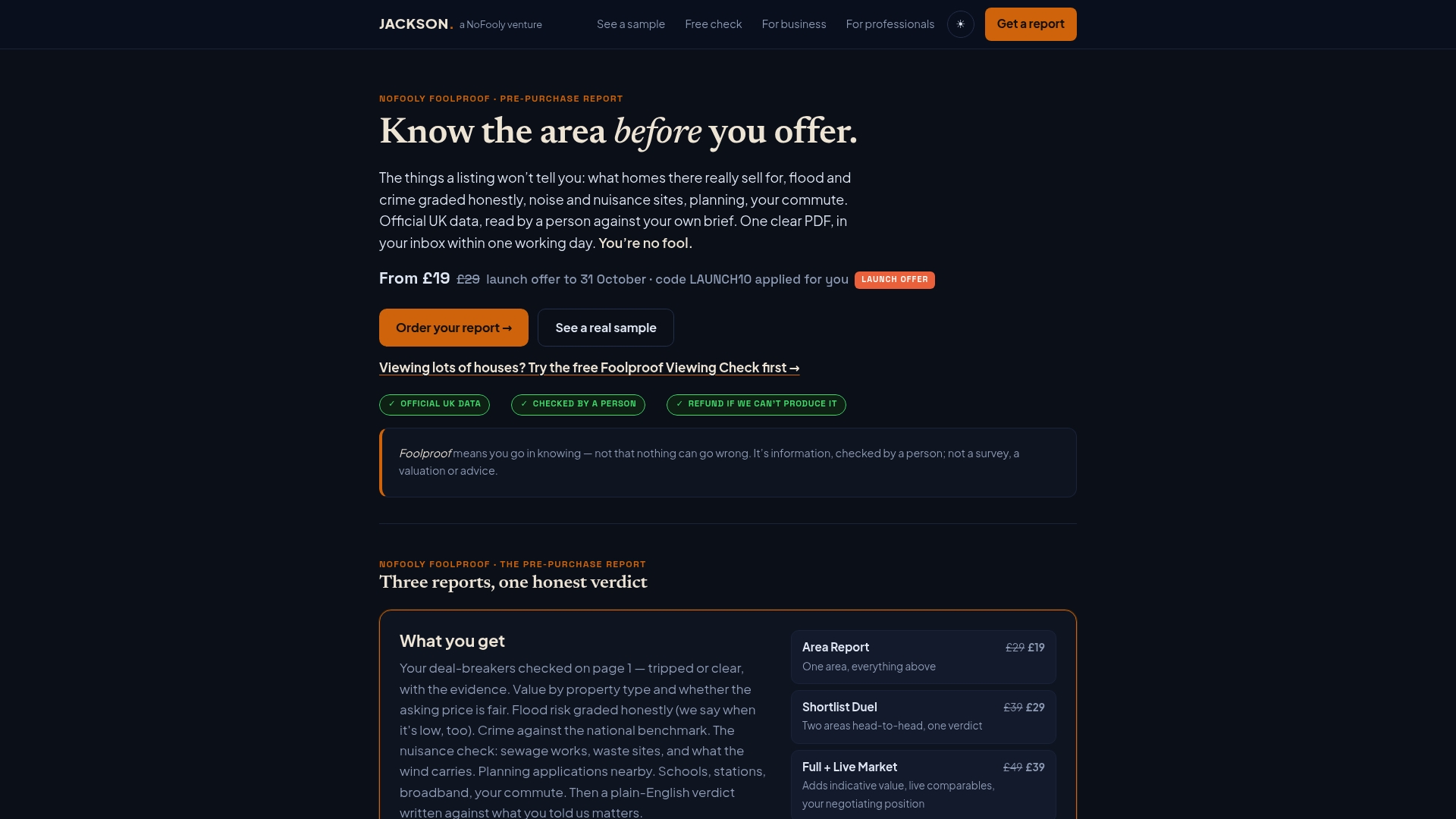
These reports are not a survey and do not replace legal or planning advice, including checks on Article 4 status or conditions attached to a specific permission. They are built for pre-exchange sense checks and for comparing shortlisted areas side by side before you go further with a solicitor or planner. Start with a free Viewing Check at NoFooly and order the report that matches how far along you are.
This article is general information, not a substitute for advice from a qualified lawyer. Consult a qualified legal professional about your own circumstances before acting on anything here.
FAQ
What are the current planning use classes in England?
The current structure centres on Class E (commercial, business and service uses), Classes F1 and F2 (learning and community uses), the C classes (residential, including C3 dwellinghouses), the B classes (industrial and storage), and sui generis uses that fall outside any class. This structure follows the 2020 Regulations that reorganised the earlier, more fragmented system.
What are the use classes B1, B2, and B8?
B1 and B2 were the pre-2020 labels for business and general industrial uses respectively. B1 was absorbed into the new Class E in 2020, while B2 remains as a separate industrial class under the current system, as set out in the Use Classes Order as amended.
Is use class A1 now use class E?
Class A1 (shops) was one of several classes merged into Class E when the 2020 Regulations came into force on 1 September 2020. A1 no longer exists as a separate class, though older documents and conditions sometimes still reference it by name.
What is class C in planning?
Class C covers residential and institutional living uses, split into C3 for ordinary dwellinghouses, C5 for secure residential institutions, and C6 for larger houses in multiple occupation. Converting a commercial building into Class C3 housing, for example under Class MA permitted development, still requires prior approval even where full planning permission is not needed.
Sources
Short on time? Let us run the checks for you
Viewing this weekend and don't fancy an afternoon of maps? The free Foolproof Viewing Check pulls the headline tiles for any address you're looking at — no card, no sign-up.
Want the whole area read by hand and written up, checked and signed off by a real person before it reaches you? That's the Jackson pre-purchase area report. Software does the legwork so it's quick and affordable; a person makes the call so you can trust it. Reports start from £19.