Property Offer Conditions in England & Wales: Subject to Contract, Survey and Mortgage, and the Evidence to Bring
Practical UK guide to property offer conditions: learn what "subject to" phrases actually protect, avoid legal pitfalls, and use £9 postcode checks to...
In England & Wales an offer is not legally binding until contracts are exchanged, whatever conditions you attach. "Subject to contract", "subject to survey" and "subject to mortgage" simply record the checks you intend to complete before that point. Scotland works differently: a written offer accepted through solicitors can bind you. Put every condition in writing to the agent.
In this guide
- Table of Contents
- What does “subject to contract” actually mean for your offer?
- Subject to survey, subject to mortgage: what each condition really covers
- How to write an offer with conditions that actually protect you
- What happens if the survey or valuation turns up a problem
- Timeline, gazumping, and what typically delays exchange
- Choosing the right conditional wording for your situation
- How area research changes the calculation before you attach conditions
- A buyer’s short checklist before you press send on an offer
- Get area evidence before you commit to conditional wording
- Sources
- FAQ
- Recommended

An offer on a UK property is generally not legally binding until contracts are exchanged, whatever wording you attach to it. Adding “subject to contract”, “subject to survey” or “subject to mortgage” simply confirms and preserves your right to walk away before that point. What these conditions cannot do is stop you losing survey and legal fees already spent, or protect you from being gazumped while contracts remain unsigned. Clear, consistent wording reduces confusion; it does not create a legal shield.
TL;DR:
- A legal offer in the UK becomes binding only after contracts are exchanged, regardless of conditional wording like “subject to survey” or “subject to mortgage.”
- Clear, consistent language is vital, as even a single email without the “subject to contract” label can unintentionally create a binding agreement.
- Conditions such as “subject to survey,” “subject to mortgage,” or “subject to sale” mainly set expectations and do not provide extra legal protection beyond pre-exchange rights.
- Precise offer details, including price, deposit, deadlines, and cost responsibilities, strengthen your position and reduce misunderstandings during negotiations.
- Reducing gazumping risk involves instructing solicitors promptly, securing mortgage in principle early, and requesting the seller to take the property off the market after your offer is accepted.
Table of Contents
- What does “subject to contract” actually mean for your offer?
- Subject to survey, subject to mortgage: what each condition really covers
- How to write an offer with conditions that actually protect you
- What happens if the survey or valuation turns up a problem
- Timeline, gazumping, and what typically delays exchange
- Choosing the right conditional wording for your situation
- How area research changes the calculation before you attach conditions
- A buyer’s short checklist before you press send on an offer
- Get area evidence before you commit to conditional wording
- Sources
- FAQ
What does “subject to contract” actually mean for your offer?
“Subject to contract” is the phrase that keeps a property negotiation from accidentally becoming a binding deal. It tells everyone involved, the seller, both estate agents, and eventually both solicitors, that whatever price and terms you’ve agreed are provisional until formal contracts are signed and exchanged.
The legal logic behind this sits in ordinary contract law. For any agreement to bind two parties, English law generally requires four things: an offer, an acceptance, consideration (usually the price), and an intention to create legal obligations. Land transactions carry an extra layer: under the Law of Property (Miscellaneous Provisions) Act 1989, a contract for the sale of land has to be in writing and signed by both parties to have effect. Verbal agreement over the phone, however enthusiastic, does not buy you a house.
Court of Appeal guidance backs this up directly. Cases examining the meaning of the “subject to contract” label confirm that using it ordinarily prevents a binding agreement from forming before exchange. That protection is not automatic, though. Courts have found binding contracts where correspondence dropped the label inconsistently, or where the conduct of the parties suggested they intended to be bound regardless of what one email said.
Pro Tip: A name typed at the bottom of an email can count as a signature in some circumstances. Never write “confirmed, let’s proceed” in an email thread that started subject to contract without repeating the label.
That risk is real enough that solicitors routinely warn clients about email chains specifically. Draft heads of terms, casual confirmations, and back and forth negotiation emails can, taken together, contain everything needed for a contract: offer, acceptance, price, and apparent intent. To avoid that trap:
- Mark every letter, email and text “subject to contract” from your very first message, not just the formal offer.
- Never use language that implies final acceptance, such as “agreed” or “deal done”, before exchange.
- Keep your estate agent’s written record of the offer consistent with what you’ve told the seller directly.
- If a clause genuinely needs to be binding early, such as a confidentiality point, say so explicitly rather than assuming the general “subject to contract” heading covers it.
Consistency is the whole game here. One stray email that reads like a firm commitment can undo weeks of careful “subject to contract” phrasing elsewhere.
Subject to survey, subject to mortgage: what each condition really covers
Buyers stack several conditions onto an offer, and each does a slightly different job. None of them creates legal rights beyond what “subject to contract” already gives you. What they do is set expectations, on paper, about what might change your mind.
- Subject to survey. This tells the seller you intend to commission a professional inspection and reserve the right to renegotiate or withdraw if it turns up something serious. HomeOwners Alliance guidance is clear that this phrase adds no extra legal protection beyond your existing pre-exchange withdrawal rights. It is a signal, not a safeguard.
- Subject to mortgage. This flags that your purchase depends on a lender releasing funds. It’s worth separating two very different checks here: a mortgage valuation is the lender protecting its own loan, checking the property is worth what you’re paying, and it is not a structural survey. A private survey, whether a HomeBuyer Report or a full building survey, is you protecting yourself against defects the lender’s valuer will never mention.
- Subject to sale of buyer’s property. Also called a linked sale, this means your purchase depends on selling your own home first. It’s honest wording, but it makes your offer far less attractive to a seller weighing you against a chain-free buyer, and it adds a second point of failure to the whole transaction.
Pro Tip: If you’re in a chain, get your own sale to the “exchanged” stage, or as close as possible, before pushing hard on a purchase offer. Sellers and agents can smell an unresolved chain a mile off, and it weakens your negotiating position from the start.
Scotland runs on a different system entirely. Under the missives process, offers and acceptances exchanged through solicitors can create binding obligations considerably earlier than in England and Wales. Conditions there have to be drafted precisely into the missives themselves, with a solicitor managing the wording, because the informal “subject to contract” safety net that English buyers rely on doesn’t work the same way north of the border.
How to write an offer with conditions that actually protect you
A vague offer invites vague trouble. Estate agents deal with dozens of buyers saying “subject to survey and mortgage” without a single specific detail attached, and sellers increasingly discount offers that read that way. Precision does two things: it makes your offer look serious, and it gives you something concrete to fall back on if the seller later claims they didn’t understand your terms.
Build your written offer around these fixed points:
- The exact price offered, stated in full figures, not “offers around.”
- The deposit amount you’re putting down and where those funds are coming from.
- The specific conditional phrases you’re attaching: “subject to contract, satisfactory survey and mortgage offer” is the common formula.
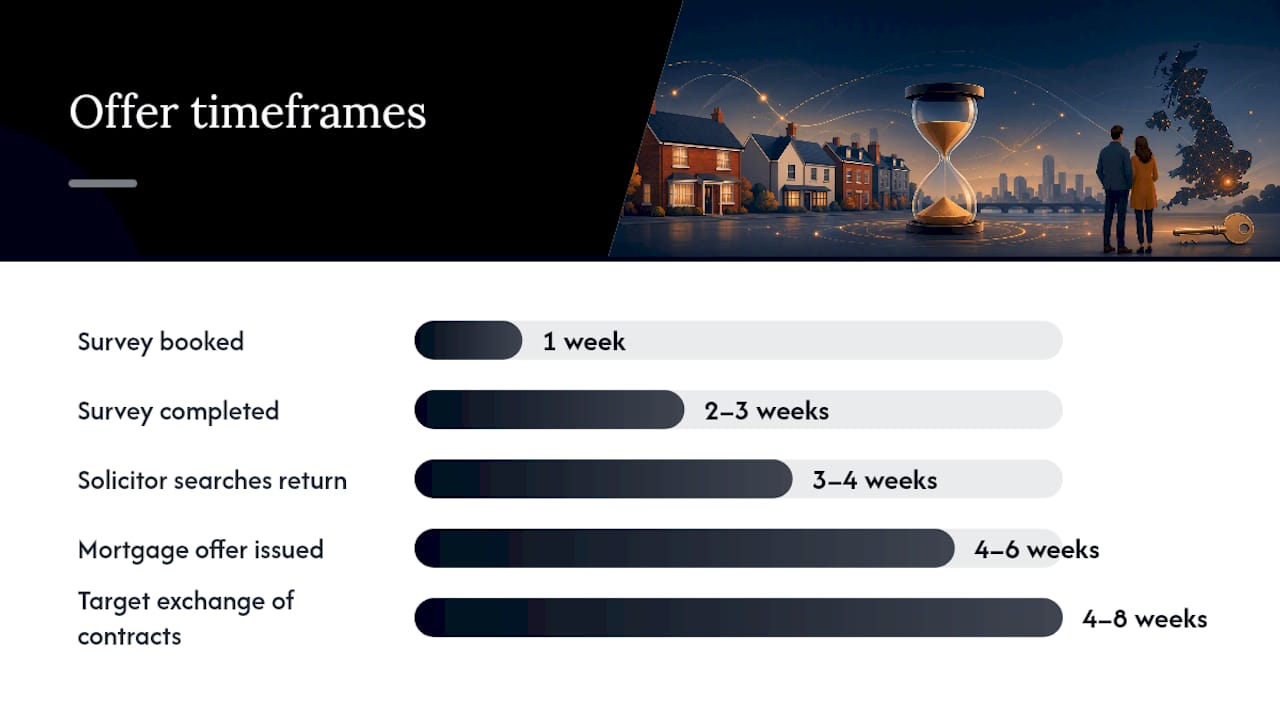
- A deadline for the survey to be completed, typically two to three weeks from acceptance.
- A deadline for mortgage offer confirmation, usually four to six weeks given current lender processing times.
- A target date for exchange of contracts, generally proposed at four to eight weeks depending on chain complexity.
- Who is expected to cover which costs: your survey fee, your solicitor’s fee, and any search costs, are yours regardless of outcome.
Once you’ve settled that wording, use it everywhere. The phrase you put in the formal written offer should match what you tell the agent verbally and what appears in your solicitor’s initial letter. Discrepancies between those three create exactly the kind of muddled record that courts have previously used to decide a contract existed when one party swore it hadn’t.
On timeframes, resist the temptation to pad deadlines “to be safe.” A generous eight week survey deadline signals to the seller that you’re not in a hurry, and sellers facing a slow buyer often keep the property marketed in parallel, exactly the scenario that leads to gazumping. Realistic but tight timescales:
- Survey booked within one week of offer acceptance, completed within two to three weeks.
- Mortgage valuation instructed the same week as the survey, mortgage offer issued within four to six weeks.
- Solicitor searches submitted within the first week, typically returning within three to four weeks depending on the local authority.
- Draft contract exchanged once searches, survey and mortgage offer are all satisfactory, targeted for week six to eight.
Pro Tip: If you want real security, ask the seller to take the property off the market once your offer is accepted. It’s not enforceable, but a seller who agrees to it and then continues showing the house to other buyers has shown you exactly what kind of seller they are.
What happens if the survey or valuation turns up a problem
A survey report is only useful once you actually do something with it. Buyers who wave a report at an agent and demand a discount with no detail attached rarely get anywhere. The stronger approach is to get a repair estimate from a builder or specialist for each significant defect, then present the seller with a specific figure and a specific request, either a price reduction matching that estimate or the seller arranging the repair before completion.
Sellers respond in a handful of predictable ways. Some will negotiate the price down to reflect the cost of repairs, which is the most common outcome for anything short of a structural issue. Some will offer to fix the problem themselves before completion, which suits sellers who have time but not spare cash. Others will refuse outright, betting that you’ll proceed anyway or that another buyer will take the property as is. HomeOwners Alliance guidance is direct on this point: sellers are under no obligation to repair anything or drop the price, and if they refuse, your only leverage before exchange is walking away.
Walking away is legally straightforward but financially uncomfortable. You lose whatever you’ve already spent, and none of it comes back:
- Your survey fee, typically running from around £400 for a basic HomeBuyer Report up to well over £1,000 for a full building survey on a larger or older property.
- Solicitor’s work already carried out, including initial searches and file opening, even if the deal collapses before exchange.
- Your mortgage valuation fee, sometimes bundled into the arrangement fee, sometimes charged separately.
It’s worth being clear about the difference between these two inspections, because buyers regularly confuse them. A mortgage valuation exists purely to reassure the lender the property is worth the loan; it is not a condition check and frequently misses problems a proper survey would catch. Your own survey, whichever level you choose, is the only document that actually tells you what’s wrong with the building itself.
Timeline, gazumping, and what typically delays exchange
From accepted offer to completion, most straightforward chain-free purchases in England and Wales take somewhere between eight and twelve weeks, with plenty running longer once a chain, a leasehold, or a slow local authority search gets involved. The rough sequence: offer accepted, solicitors instructed within days, survey and searches running in parallel over the following few weeks, mortgage offer issued once the valuation clears, draft contracts exchanged once everyone’s satisfied, then completion follows on an agreed date, sometimes the same day as exchange, sometimes weeks later.
Gazumping sits at the centre of most buyer anxiety in this window, and for good reason: it remains entirely possible in England and Wales because nothing binds the seller before exchange either. A seller can accept a higher offer from someone else the day before you were due to exchange, and you have no legal recourse. Reducing your exposure means moving fast rather than hoping for the best:
- Instruct a solicitor the same day your offer is accepted, not once you’ve had time to think about it.
- Get a mortgage in principle sorted before you even start viewing seriously, so lender delays don’t stack on top of everything else.
- Ask the seller and agent, in writing, to take the property off the market once your offer is accepted.
Pro Tip: If a seller refuses to take the property off the market after accepting your offer, treat that as a warning sign rather than standard practice. It’s the single clearest signal that gazumping risk is elevated on that particular purchase.
A handful of issues cause most exchange delays: unresolved title problems (missing planning permission for an extension, absent building regulations sign off), local authority searches that take longer than expected, and mortgage offers held up by lender underwriting queries. None of these are unusual, which is exactly why realistic timescales matter more than optimistic ones.
Choosing the right conditional wording for your situation
There’s no single “correct” set of conditions to attach to an offer. The right combination depends on how competitive the property is, how exposed you are financially, and what kind of buyer you are. Every condition you add buys you flexibility and costs you competitiveness in equal measure; a seller comparing two similar offers will often favour the one with fewer strings attached, even at a slightly lower price.
Match your wording to your position:
- First-time buyers with no chain and a mortgage in principle already arranged should keep wording simple: “subject to contract, satisfactory survey and mortgage offer.” You’re already an attractive buyer; don’t dilute that with unnecessary caveats.
- Chain buyers need to be upfront rather than hopeful: “subject to contract, satisfactory survey, mortgage offer, and sale of my property at [address], currently at [stage].” Vague chain wording gets discounted by agents instantly.
- Cash buyers can drop the mortgage condition entirely, which is genuinely one of the strongest positions in any negotiation: “subject to contract and satisfactory survey” alone, with proof of funds attached, often unlocks a lower accepted price.
- Investors buying to let should still insist on a survey condition even under time pressure. Skipping it to move faster on a competitive property is the single most common way an investment purchase turns into an expensive repair bill.
How area research changes the calculation before you attach conditions
Deciding what to offer, and which conditions to attach, gets easier once you know what’s actually happening around the property, not just inside it. A Nofooly area report pulls sold prices by street and property type, planning applications next door, flood risk and recorded flood history, crime data, noise and nuisance sites, broadband speed, and commute times, then adds a plain-English verdict.
Knowing that three similar houses on the same street sold for less than you’re about to offer, or that a planning application for a rear extension next door was refused last year, changes what a fair offer actually looks like. It also flags which conditions matter most: flood history strengthens the case for a full survey rather than a basic one, for instance.
None of this replaces a survey or legal advice. Nofooly reports don’t check building condition, damp, subsidence or gas and electrical safety, and they don’t read title deeds or conveyancing searches. They cover England and Wales only. Order one alongside instructing your solicitor and booking your survey, not instead of either.
A buyer’s short checklist before you press send on an offer
Before you email an agent with a figure attached, run through the basics: is your mortgage in principle actually in place, have you budgeted for a survey rather than assuming the lender’s valuation covers you, and have you written “subject to contract” consistently in every message so far, not just the final offer?
Decide your deadlines before you negotiate, not during. A realistic survey and exchange timescale protects you more than an aggressive one ever will.
The hardest part isn’t the wording, it’s the detachment. If a survey turns up something serious and the seller won’t budge, walking away is the right call more often than pride wants to admit, even after you’ve spent money you won’t get back. If you’re unsure whether the number you’re about to offer actually reflects the street, that’s the moment to check a postcode report rather than guess.
Get area evidence before you commit to conditional wording
Nofooly exists for the gap between “I like this house” and “I know what to offer.” Rather than negotiating on gut feeling, or paying an agency for a report a person never actually reads, you get a plain-English postcode check built specifically for the offer you’re about to make.

The free Viewing Check gets you started, and the £9 Instant Report gives sold prices, planning activity, flood history, crime and broadband for any postcode in England and Wales, generated fast and checked before it reaches you. Step up to the £29 Area Report and a named analyst reads it against your own written brief and deal-breakers, adding sale history, tenure, and a read on whether the asking price stacks up locally. Comparing two shortlisted areas head to head costs £39, and the £49 Full + Live Market tier adds an indicative valuation, live comparables and a negotiating position.
None of it is a survey, legal advice, or a mortgage valuation, and it covers England and Wales only. What it gives you is the local evidence to back the number you’re about to put in writing. Order your report before you finalise your offer wording.
Sources
For the legal basics on when an offer binds, GOV.UK’s guidance on making an offer is the starting point every buyer should read first. For survey costs and how to use a survey report in negotiation, the HomeOwners Alliance guide to house survey costs covers practical detail GOV.UK doesn’t. On the risks of loose “subject to contract” wording, the Court of Appeal commentary from BCLP is worth reading in full before you send a single negotiation email. Buyers in Scotland should speak to a solicitor early about how missives affect their own conditional offer strategy.
This article is general information, not a substitute for advice from a qualified lawyer. Consult a qualified legal professional about your own circumstances before acting on anything here.
- Buying a home: Making an offer
- How much does a house survey cost? | HomeOwners Alliance
- Marking your letter ‘subject to contract’: what does the label mean? | BCLP
FAQ
What is an acceptable offer on a house in the UK?
There’s no fixed rule; an acceptable offer depends on how the asking price compares to recent sold prices on that street, how long the property has been listed, and how many other interested buyers exist. Checking actual sold prices by street and type, rather than relying on the asking price alone, is the most reliable way to judge whether your figure is realistic.
Is it okay to offer 10% below the asking price?
Offering 10% below asking is common and often reasonable, particularly on a property that’s been listed for several weeks with no other interest. It’s far less likely to succeed on a freshly listed, well-priced home in a competitive area, so the right discount depends heavily on local demand rather than a fixed percentage.
Can a house fall through after an offer is accepted?
Yes, and it happens regularly, because an accepted offer isn’t legally binding in England and Wales until contracts are exchanged. Either side can walk away before that point, whether due to survey findings, mortgage problems, or a seller accepting a higher offer from someone else.
How much should I offer on a property listed as “Offers in Region of”?
“Offers in Region of” (OIRO) signals the seller has some flexibility but expects offers close to that figure rather than substantially below it. A sensible starting point is checking sold prices for comparable properties nearby, then offering within roughly 5% either side of the guide figure unless local evidence clearly justifies going lower.
Recommended
Short on time? Let us run the checks for you
Viewing this weekend and don't fancy an afternoon of maps? The free Foolproof Viewing Check pulls the headline tiles for any address you're looking at — no card, no sign-up.
Want the whole area read by hand and written up, checked and signed off by a real person before it reaches you? That's the Jackson pre-purchase area report. Software does the legwork so it's quick and affordable; a person makes the call so you can trust it. Reports start from £29.