Challenge a Service Charge Hike, and What to Check Before You Buy a Flat (England and Wales)
England and Wales guide to service charge increases: what documents to demand, how to challenge charges, and the pre-purchase area checks that give early warning on a block.
In this guide
- Table of Contents
- When a service charge increase is lawful
- Why charges rise and how landlords calculate them
- Documents to demand: your evidence checklist
- How to challenge a service charge increase
- Cutting the immediate financial hit
- How a pre-purchase area report gives early warning before you buy
- Realistic expectations for leaseholders fighting back
- Where to find the official guidance
- Sources
- FAQ
- Recommended

Most increases are lawful if your lease allows it and the landlord followed the correct process, but that’s a big “if”. Before paying, put a written request in for the service charge summary and supporting invoices; landlords who refuse may be committing an offence, according to GOV.UK. Given that 66.1% of leaseholders in one campaign group’s member survey report overcharging, scrutiny is worth your time.
TL;DR:
- Leaseholders should request the service charge summary and supporting invoices in writing before paying, especially since over 66% in one survey report overcharging, to verify the legitimacy of increases.
- Major work costs must follow a Section 20 consultation process; skipping this step can limit recoverable charges, and proper notice and documentation are legally required.
- Common causes of rising charges include inflation and emergency repairs, but increases of 21 to 50% annually are typical, with some responses reporting over 100% rises, especially in London.
- Apportionment methods like fixed percentages or floor area splits can inflate bills without actual cost increases, making it crucial to scrutinize how charges are allocated.
- In disputes, leaseholders should escalate through informal requests, formal complaints, and, if necessary, the First-tier Tribunal, with efforts more successful when supported by invoices and contractor quotes.
Table of Contents
- When a service charge increase is lawful
- Why charges rise and how landlords calculate them
- Documents to demand: your evidence checklist
- How to challenge a service charge increase
- Cutting the immediate financial hit
- How a pre-purchase area report gives early warning before you buy
- Realistic expectations for leaseholders fighting back
- Where to find the official guidance
- Sources
- FAQ
When a service charge increase is lawful
Your lease is the rulebook. Most leases let the landlord recover “reasonable” costs of managing and maintaining the building, but only for items actually listed as recoverable. If a lease excludes, say, cosmetic communal upgrades or legal fees from disputes, and the landlord bills for them anyway, that portion of the increase is challengeable regardless of how the maths adds up.

Notice matters as much as the number itself. For qualifying major works above a set threshold, landlords must run a Section 20 consultation, giving leaseholders the chance to comment on proposed contractors and costs before work starts. Skipping that step can cap what the landlord can recover, even if the works were genuinely needed.
Checks worth running against any demand:
- Does the lease clause cited actually cover the item being charged?
- Was proper written notice given, and within the timeframe the lease specifies?
- If the charge relates to major works, was a Section 20 consultation carried out?
- Does the demand include, or refer you to, a statutory summary of costs?
GOV.UK is explicit that leaseholders have a right to a service charge summary and to inspect the invoices and accounts behind it. That right exists whether or not the landlord volunteers it.
Why charges rise and how landlords calculate them
Inflation on contractor labour, insurance premiums and utility costs is the most commonly cited driver, and it’s often genuine. Emergency repairs, particularly lift failures, roof leaks and fire safety remediation, can also push a single year’s bill well above the historic average. None of that makes every rise automatically fair.
The most commonly reported single jump in a sector survey was an increase of 21 to 50% in one year, and 11.7% of respondents reported their charge more than doubling. London leaseholders were more likely than those elsewhere to report rises over 100%.
Some of that scale is context, not just cost. Reporting from Bristol documents individual cases where residents faced increases of several hundred per cent, with average annual charges climbing markedly since 2016.
Apportionment is where numbers can quietly inflate. Charges are typically split by floor area, by a fixed percentage written into each lease, or by an equal share per flat. A block that switches its accounting method, or misapplies the split, can produce a bill increase that has nothing to do with actual costs rising:
- Fixed percentage per lease (most common in older developments)
- Equal share regardless of flat size
- Floor area or “rateable value” based splits
Documents to demand: your evidence checklist
Ask for these in writing, and keep a dated copy of your request. Landlords typically have a limited window to respond once asked formally, and a paper trail matters if you later need the Tribunal.
- The statutory service charge summary for the relevant accounting year, broken down by cost category.
- Original supplier invoices and contractor contracts underpinning the largest line items.
- Insurance schedules showing premium changes and what’s covered.
- Tender or quotation records for any major works, especially where Section 20 applies.
- Reserve fund (sinking fund) statements, showing contributions, withdrawals and current balance.
- The management agreement, so you can see what the managing agent is contractually entitled to charge for.
Pro Tip: Even a technically correct calculation can be impossible to verify from a summary alone. Insist on the underlying invoices, not just the totals, since readable breakdowns are often the only real way to confirm fairness.
How to challenge a service charge increase
Escalate in stages rather than jumping straight to a tribunal, which is slower and more adversarial than most disputes need to be.
- Informal request – write to the managing agent asking for clarification and the documents above. Keep it factual and dated.
- Formal written complaint – if the response is inadequate, submit a formal complaint through the landlord’s complaints procedure, referencing the specific figures you dispute.
- Housing Ombudsman – if the complaint concerns poor process, opacity, or how your complaint was handled rather than the sum itself, the Ombudsman can investigate and order a remedy.
- First-tier Tribunal – for genuine disputes about whether an amount is payable or reasonable, the Tribunal can rule on the actual figure.
A few things worth knowing before you start:
- The Ombudsman usually cannot reduce the underlying charge itself; it typically orders compensation or process fixes for poor service.
- The Tribunal can rule on whether costs are reasonable and payable, which is where Section 20 failures often bite hardest.
- Model letters and step-by-step guidance exist specifically for challenging these charges, and following that structure tends to get a faster, clearer response than an open-ended complaint.
Challenges succeed more often when leaseholders bring original invoices and contractor quotes to the table rather than arguing that a figure simply feels too high.
Cutting the immediate financial hit
You don’t have to resolve the dispute before protecting your cash flow. Ask the landlord in writing for a phased payment plan; many will accept instalments rather than risk a drawn-out non-payment dispute.
- Request a written instalment arrangement before the due date, not after you’ve missed it.
- Team up with neighbours to request the same documents collectively. A joint letter from six flats lands differently to the same letter sent alone.
- Check whether Right to Manage is realistic for your block; it shifts management control to leaseholders but only pays off where enough flats commit.
- Confirm which accounting year each cost was charged to. Costs booked to the wrong year are a common, quietly correctable error.
Pro Tip: Before threatening a Tribunal application, check the reserve fund balance. If the landlord is drawing down a healthy reserve while also raising your annual charge, that’s a specific, evidenced question to put to them in writing.
How a pre-purchase area report gives early warning before you buy
If you’re buying rather than already living somewhere, the smarter move is spotting a problem block before exchange, not after. This is where a data-led postcode check earns its keep. Nofooly’s tiered area reports start with a free automated Viewing Check, then the £9 Instant Report, the £29 Area Report checked against your own written brief, the £39 Shortlist Duel comparing two areas, and the £49 Full + Live Market with an indicative valuation read.
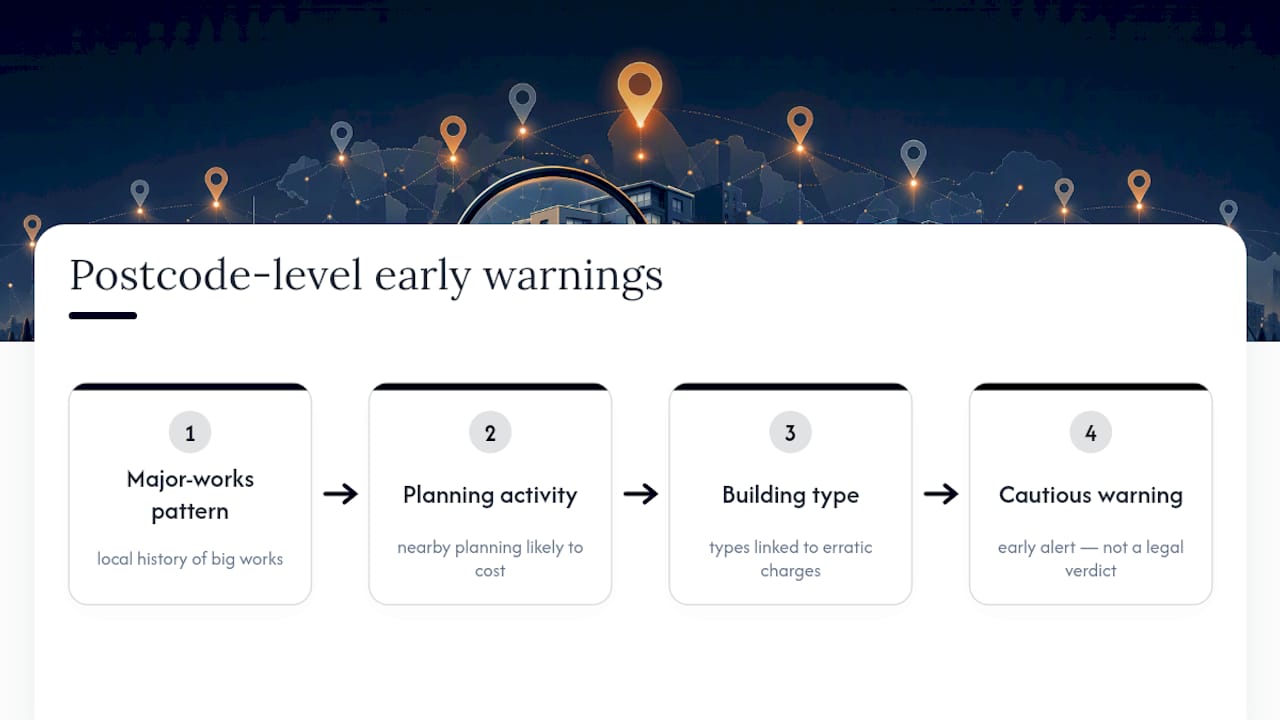
None of these are a survey, and none replace a conveyancer reading the lease terms or a solicitor’s enquiries. What a postcode-level read can flag is context: planning applications next door that could mean disruption or a change to the block’s surroundings, the flood picture that feeds building insurance premiums, noise and nuisance sites, and how the area’s sold prices are moving. It cannot see the lease, the reserve fund or the block’s service charge history; ask the seller for those and have your conveyancer read them. That’s a useful early warning, not a legal verdict.
Realistic expectations for leaseholders fighting back
Transparency across the sector remains genuinely poor, and government reform is slow. But most successful challenges rest on paperwork, not outrage: get invoices early, coordinate with neighbours, and reserve professional advice for sums that justify the cost.
— Gracie C
Where to find the official guidance
Start with the primary sources rather than secondhand summaries:
- Gov for your statutory rights.
- Lease-advice for model letters and Section 20 detail.
- Bristol Live’s reporting for real-world context on how extreme these increases can get.
This article is general information, not legal advice. Consult a solicitor or the Leasehold Advisory Service (LEASE) about your own circumstances before acting on anything here.
Sources
- Leasehold property: Service charges and other expenses
- Leaseholders: gov announces next steps on service charges and leaseholder rights
- Skyrocketing service charges stun housing association tenants | Bristol Live
- Landlord Service Charge Abuse (SHAC member survey 2026)
FAQ
What is a reasonable increase in service charge?
There’s no fixed legal percentage that counts as “reasonable”; it depends on whether the costs behind it are genuine, properly incurred, and match what the lease allows. The most commonly reported single-year jump in a recent survey was 21 to 50%, which gives some sense of typical scale, but a much smaller rise can still be unreasonable if it’s not backed by evidence.
Can I refuse to pay a service charge?
Withholding payment outright is risky and can lead to arrears action or even forfeiture proceedings in extreme cases, so it’s rarely advisable without professional advice. The safer route is to pay under protest while formally challenging the disputed amount through the complaint process or the First-tier Tribunal.
Do I legally have to pay a service charge?
Yes, if your lease requires it and the charge is properly demanded and reasonable, payment is a contractual obligation. You do, however, have a statutory right to see the summary and supporting invoices behind any charge, and landlords who refuse that request may be committing an offence.
What is the average service charge in the UK?
Figures vary widely by block and location, but reporting has cited average annual charges rising sharply since 2016, alongside individual cases of service charges increasing by several hundred per cent. If your own increase looks far outside that pattern, it’s worth demanding the underlying invoices before assuming it’s justified.
Recommended
Short on time? Let us run the checks for you
Viewing this weekend and don't fancy an afternoon of maps? The free Foolproof Viewing Check pulls the headline tiles for any address you're looking at — no card, no sign-up.
Want the whole area read by hand and written up, checked and signed off by a real person before it reaches you? That's the Jackson pre-purchase area report. Software does the legwork so it's quick and affordable; a person makes the call so you can trust it. Reports start from £29.