Unadopted Roads: Who Pays, How to Check, and What to Ask Before You Buy (England & Wales)
How to tell if a road is unadopted, who pays for repairs, and what to confirm with your conveyancer before exchange. A NoFooly area report (from £29) shows the wider picture alongside.
In this guide
- Table of Contents
- What counts as an unadopted road under UK law?
- Who actually owns the road and pays for its upkeep?
- How to tell if a road is unadopted before you buy
- What are the risks and costs if the road stays unadopted?
- How does a road actually get adopted?
- Can the council force repairs and recover the cost?
- Buying or living on an unadopted road: your action checklist
- What a proper pre-purchase check adds beyond a standard search
- Why buyers underestimate this until it costs them
- Get a clear answer on unadopted-road risk before you exchange
- Sources
- FAQ
An unadopted road is a highway not maintained at public expense, meaning the council has no legal duty to repair it. The frontagers, the owners of properties fronting the road, usually carry the cost of upkeep and repair between them. If you’re buying or already own a property on one, the immediate move is to check the deeds and the Land Registry title, and ask your conveyancer to confirm the road's status before you commit to anything.
TL;DR:
- Most unadopted roads are owned and maintained by frontagers, meaning residents are responsible for costs, including resurfacing and drainage.
- Councils often undertake limited work like lighting repairs without adopting the road, so visible maintenance does not confirm official adoption.
- Checking the council’s adopted-streets map, Land Registry records, deeds, and requesting local authority searches are essential steps before purchasing a property.
- Repair costs for unadopted roads can be significant, sometimes running into thousands of pounds, especially if residents fail to maintain the surface or the council steps in.
- Your conveyancer's searches and the Land Registry title establish road status and liability; a pre-purchase area report adds the wider picture (flood, planning, nuisance, local prices) so you can weigh the whole move, not one risk in isolation.
Table of Contents
- What counts as an unadopted road under UK law?
- Who actually owns the road and pays for its upkeep?
- How to tell if a road is unadopted before you buy
- What are the risks and costs if the road stays unadopted?
- How does a road actually get adopted?
- Can the council force repairs and recover the cost?
- Buying or living on an unadopted road: your action checklist
- What a proper pre-purchase check adds beyond a standard search
- Why buyers underestimate this until it costs them
- Get a clear answer on unadopted-road risk before you exchange
- Sources
- FAQ
What counts as an unadopted road under UK law?
The Highways Act 1980, Part XI sets the legal framework. It classes an unadopted road as a highway “not maintainable at public expense,” which sounds bureaucratic but has a very concrete effect: the local council has no statutory obligation to resurface it, fill potholes, clear gullies, or fix streetlights. That job falls to whoever owns the road, usually the residents whose properties sit alongside it.
This is different from a “private street,” a term often used interchangeably but with its own legal nuance, and different again from a road that carries public rights of way. A road can be unadopted and still be a public highway in the sense that anyone has a legal right to walk or drive along it, even though no authority is obliged to maintain the surface. Public access and public maintenance are two separate questions, and mixing them up is one of the most common mistakes buyers make.
The scale of the issue is bigger than most people assume. A 1972 Department of Transport survey counted roughly 40,000 unadopted roads in England and Wales, covering around 4,000 miles of road. A 2009 government estimate put the cost of bringing every one of them up to an adoptable standard at around £3 billion. Those figures are decades old in parts, but they capture something that hasn’t changed: this is a nationwide problem, not a quirk affecting a handful of unlucky postcodes.
Who actually owns the road and pays for its upkeep?
Ownership of an unadopted road usually sits with the frontagers, the people who own the properties bordering it. Where the deeds don’t name a specific owner for the road itself, the common presumption is that each frontager owns the road surface up to its midpoint. That means you might own a slice of tarmac outside your house without ever realising it, along with a share of the liability that comes with it.
On new-build estates, the developer typically holds responsibility for the road until it’s either adopted by the council or formally transferred to a residents’ management company. This is a common flashpoint: buyers on new estates are frequently told adoption is “in progress,” sometimes for years, while the developer or a management company quietly bills residents for interim upkeep.
Maintenance on an unadopted road covers more than filling in cracks. It typically includes resurfacing, drainage and gully clearance, streetlighting repairs, and dealing with subsidence or verge damage. None of this is free, and none of it is guaranteed to happen unless the frontagers organise and fund it themselves.
Here’s the misconception that trips up even careful buyers: seeing council-branded streetlights, a council bin collection, or the odd pothole patch does not mean the road has been adopted. Councils sometimes carry out limited work on unadopted roads for safety reasons, or maintain lighting under separate arrangements, without taking on the road itself. As Milton Keynes Council’s guidance makes clear, occasional council activity is not proof of adoption, and relying on it as reassurance is a mistake.
How to tell if a road is unadopted before you buy
You don’t need to guess. There are a handful of reliable checks, and running through all of them takes less time than a single viewing.
- Check the council’s adopted-streets map. Most local authorities publish a list or GIS map showing which roads they maintain. If a road isn’t on it, treat it as unadopted until proven otherwise.
- Search the Land Registry title. The title register or plan often names the road owner, or at least confirms whether the road is registered separately from the property.
- Read the property deeds carefully. Older deeds sometimes include maintenance covenants, rights of way, or references to a road maintenance company that a quick title search might miss.
- Ask the seller or developer directly. Request written confirmation of the road’s status, and ask whether adoption has ever been promised or applied for.
- Instruct your conveyancer to run a local authority search. This is the formal route to get a definitive answer, and it should flag any outstanding adoption agreements or disputes.
Don’t be fooled by appearances. A road with pavements, streetlights, and a council-issue road sign can still be entirely unadopted, and the only way to know for certain is to check the paperwork.
What are the risks and costs if the road stays unadopted?
The financial exposure varies enormously depending on the road’s condition, but it’s rarely trivial. Resurfacing a badly degraded private road can run into thousands of pounds per household once the cost is split between frontagers, and that’s before you factor in drainage work or lighting repairs. The 2009 estimate of £3 billion nationally to bring unadopted roads up to standard gives a sense of how deep this problem runs across the country.
There’s a sharper risk hiding in the background: if frontagers refuse or fail to fix a road that’s become dangerous, the council can step in, carry out the repairs itself, and then bill the owners for the cost. What starts as “not my problem, the council will handle it eventually” can turn into an unwelcome invoice with statutory backing.
Mortgage lenders and insurers pay attention to this too. Some lenders will ask specific questions about road maintenance liability during the conveyancing process, and a poorly drafted or missing maintenance agreement can slow down or complicate a mortgage offer. It’s not usually a dealbreaker, but it’s exactly the kind of thing that causes delays close to completion, when nobody wants surprises.
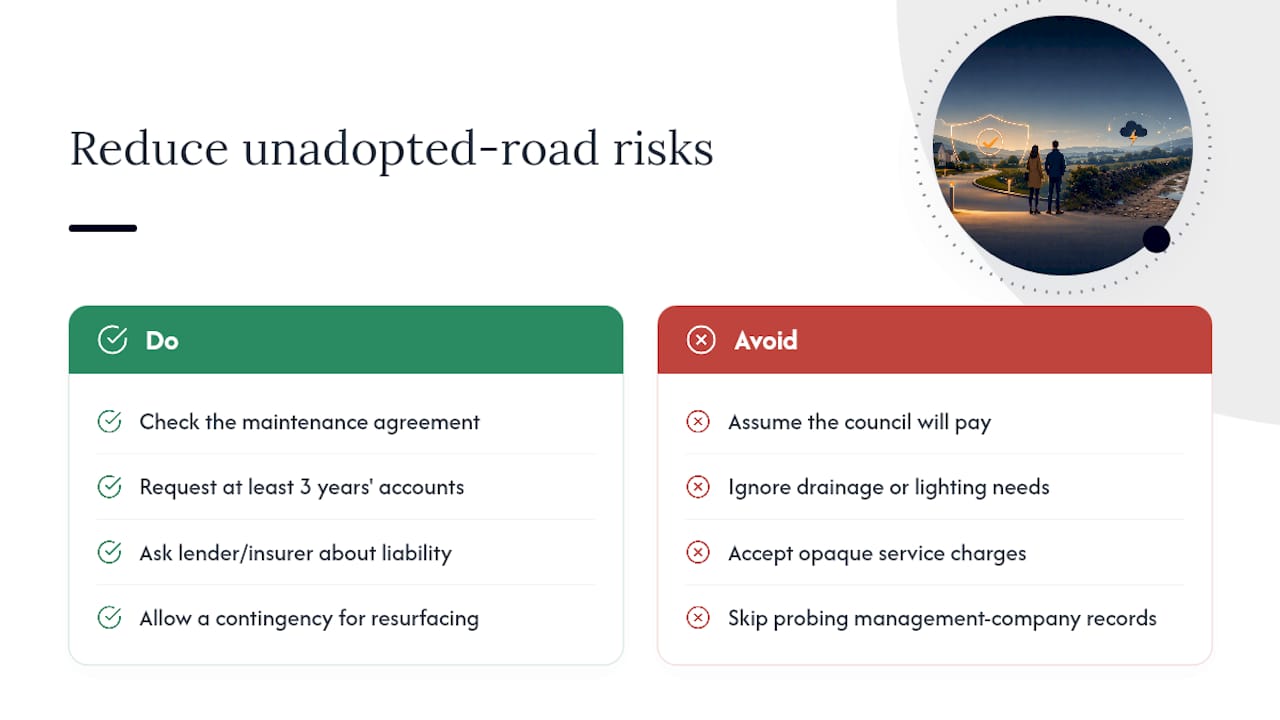
On many modern estates, a management company handles the unadopted road (and often the drainage, verges, and communal areas) in exchange for an annual service charge. This can work well when the company is well run, but it can also mean opaque fees, inconsistent maintenance standards, and disputes over what the charge actually covers. Ask for at least three years of accounts before you buy into one of these arrangements, not just the sales brochure figure.
How does a road actually get adopted?
The formal mechanism is a section 38 agreement, named after the relevant section of the Highways Act 1980. Under this process, the developer or frontagers can offer the road to the council for adoption, but the council will only accept it once the road meets its construction and design standards, covering things like kerb height, drainage capacity, and streetlighting specification, as official adoption guidance sets out.
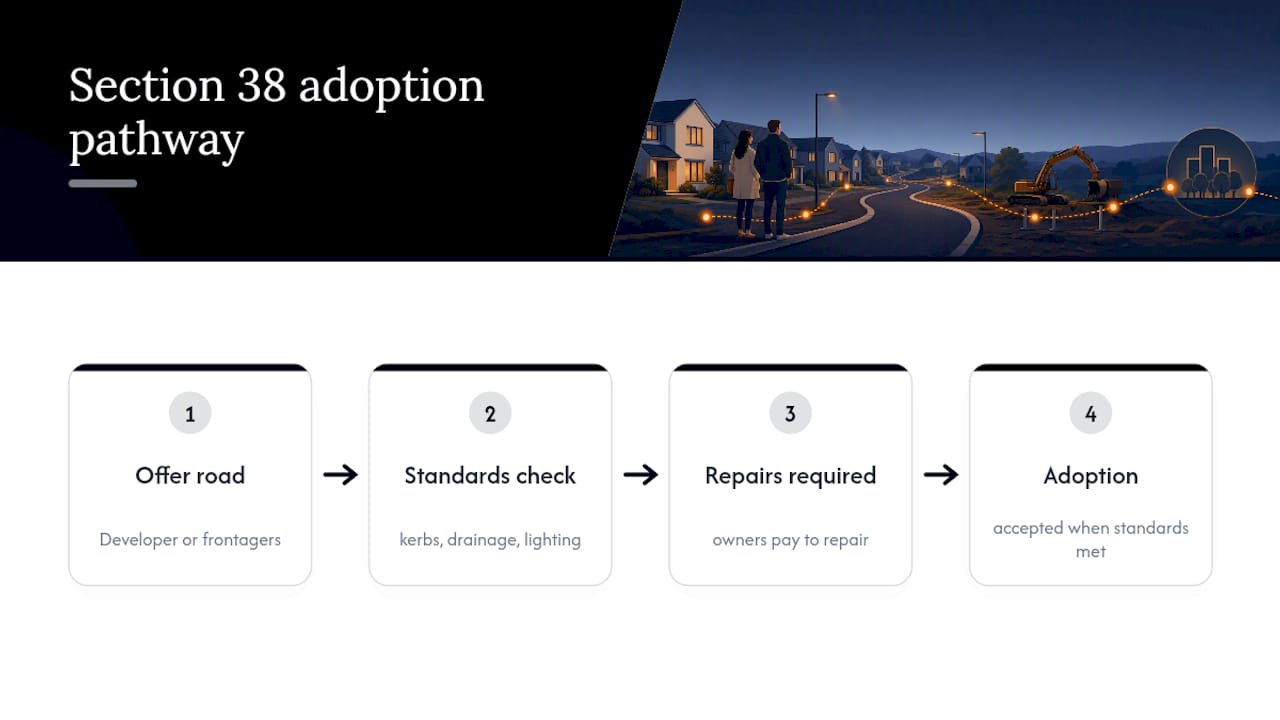
Whoever is offering the road up generally has to pay to bring it up to that standard first. On a new estate, this cost usually sits with the developer as part of the original planning obligations. On an older unadopted road with no developer left standing, it falls to the frontagers, and the bill for full reconstruction to an adoptable standard can be substantial enough that many groups of residents never pursue it.
Councils are under no obligation to accept an offer of adoption, even when the work looks complete to a layperson. Milton Keynes Council’s guidance is blunt about this: adoption won’t happen until every technical box is ticked, and any shortfall in standards has to be fixed at the owners’ expense before the council will even consider taking the road on.
In practice, timelines vary wildly. On new estates, adoption can take anywhere from one to several years after the last house is occupied, partly because councils often wait for the full development to finish before inspecting the roads as a whole. For older, informally built roads with no section 38 agreement in place, adoption can stall indefinitely unless residents organise, fund the upgrade, and push the application through themselves.
Can the council force repairs and recover the cost?
Yes, in certain circumstances. The Highways Act gives councils statutory powers to intervene where a private street presents a danger to traffic or pedestrians, even though the council has no general duty to maintain it. If frontagers won’t fix a hazard, the council can carry out the necessary works itself and recover the cost from the owners afterwards.
The usual sequence starts with the council issuing notice to the owners, giving them a chance to complete repairs within a set period. If nothing happens, the council can do the work directly and then pursue frontagers for reimbursement, sometimes through a legal charge against the property if the debt isn’t settled.
If you’re facing a genuinely dangerous unadopted road, whether it’s a collapsed section of surface, exposed drainage, or failed lighting on a route used by children, report it to the council’s highways team rather than waiting for neighbours to organise a private fix. Emergency safety issues get a faster response than routine maintenance complaints, and a documented report also protects you if a dispute over liability arises later.
Buying or living on an unadopted road: your action checklist
Before you exchange contracts on a property with an unadopted road, get answers to the following in writing, not just verbally from the estate agent.
- Is the road currently adopted, part-adopted, or entirely private, and can the seller provide documentary proof either way?
- Has adoption ever been applied for, and if so, what’s the current status with the council?
- Is there a management company involved, and what does the service charge actually cover?
- Are there any outstanding disputes, unpaid contributions, or legal charges relating to road maintenance?
- What condition is the road surface, drainage, and lighting in right now, not just in the listing photos?
On the search side, commission a local authority search through your conveyancer, pull the Land Registry title plan yourself (it’s cheap and quick), and ask for the estate’s original section 38 agreement if one exists. If the road is clearly unadopted and in poor condition, that’s a legitimate point to negotiate on: a price reduction, a retention held in escrow until repairs are completed, or a contractual commitment from the seller to contribute towards a known upcoming resurfacing bill.
Pro Tip: Don’t rely solely on the standard conveyancing searches to flag unadopted-road risk. They confirm legal status, not practical condition or the likely size of a future repair bill. Get the road's status confirmed by your conveyancer, and weigh it against the area's wider picture, before you make an offer, not after.
This is exactly the point at which a plain-English read of the wider area earns its cost. Your conveyancer interprets the legal status and the council's records; a pre-purchase area report puts that alongside flood risk, planning, nuisance and local prices, so you are not weighing one risk in isolation the night before exchange.
What a proper pre-purchase check adds beyond a standard search
Standard conveyancing searches confirm legal status; they rarely tell you what an unadopted road is likely to cost you in five years or whether the management company’s accounts look sound. That gap is where a joined-up, human-checked view of deeds, Land Registry data, and council records earns its place, cross-referencing sources that a routine search often treats separately.
A pre-purchase area report is built for the other half of that gap. It does not read the title or settle the legal position; that is the conveyancer's job. What it gives you is a plain-English verdict on the area, written against your own brief, that you can actually use at the negotiating table, and the questions worth raising with the seller before you commit.
Why buyers underestimate this until it costs them
The mistake I see most often isn’t ignorance of the law. It’s assuming that because a road looks maintained, someone official must be responsible for it. That assumption is exactly backwards on an unadopted road, and it’s the gap between what a street looks like and what the deeds actually say that catches people out, sometimes years after they’ve moved in and the first big resurfacing bill lands.
Buyers rarely walk away from a property purely because a road is unadopted. What tends to go wrong is buying without knowing, then discovering the liability at the worst possible moment, mid renovation, mid sale, or mid dispute with a neighbour who won’t pay their share. Order the checks before you exchange, not after.
— Wayne
Get a clear answer on unadopted-road risk before you exchange
If you’ve read this far weighing up a property on a road you’re not sure about, you already know the standard searches won’t give you the full picture. A pre-purchase area report is not a substitute for that paperwork, and it does not rule on the road's legal status. What it gives you is a single human-checked report with a plain-English verdict on the area, so an unadopted road is weighed alongside everything else that matters about the move.

The Nofooly Foolproof report covers flood risk, crime, planning applications, nuisance sites and recent sold and asking prices for the area, all compiled from official UK data and checked by a named person rather than left as a raw data dump. It does not check road adoption or title; that stays with your conveyancer. Reports start from £29 and cover England and Wales only. If you’re weighing up an offer on a property with an unadopted road, order a report before you commit, not after you’ve already exchanged.
Sources
For primary law and official guidance, consult the Highways Act 1980, the House of Commons briefing on unadopted roads, Milton Keynes Council’s adoption guide, Pendle Borough Council’s unadopted streets page, and the gov.uk advice note on road adoptions.
This article is general information, not a substitute for advice from a qualified lawyer. Consult a qualified legal professional about your own circumstances before acting on anything here.
- Private, or ‘unadopted’ roads in England and Wales
- Highways Act 1980 (Part XI)
- A4 mini guide - adopted and unadopted highway (Milton Keynes Council)
- Gov
FAQ
How can I tell if a road is unadopted?
Check your local council’s adopted-streets map or GIS tool, search the Land Registry title for the road, and ask your conveyancer to run a local authority search. Council streetlights or occasional maintenance are not proof of adoption.
What are the rules for maintaining an unadopted road?
There’s no automatic legal duty on the council; responsibility usually falls to the frontagers, or to a developer or management company on newer estates, until the road is formally adopted under a section 38 agreement.
Is it okay to buy a house on an unadopted road?
It can be a perfectly sound purchase, but you need to know the road’s condition, who’s liable for repairs, and whether any adoption process is underway before you exchange. Your conveyancer confirms the road's position; a pre-purchase area report from a service like Nofooly then shows the rest of the area's picture, so the road is one known factor rather than a guess about the whole move.
Can I park outside my house on an unadopted road?
Not automatically. There’s no inherent right to park on an unadopted street, and persistent parking can amount to trespass against whoever owns the road surface, so check the deeds or ask the council before assuming it’s fine.
Short on time? Let us run the checks for you
Viewing this weekend and don't fancy an afternoon of maps? The free Foolproof Viewing Check pulls the headline tiles for any address you're looking at — no card, no sign-up.
Want the whole area read by hand and written up, checked and signed off by a real person before it reaches you? That's the Jackson pre-purchase area report. Software does the legwork so it's quick and affordable; a person makes the call so you can trust it. Reports start from £29.