Ofsted Ratings Explained: What the New Grades Mean
Ofsted report cards replaced single-word ratings in England. What each grade means, how to read a report, and how to weigh it when choosing an area.
Since November 2025, Ofsted gives England's state-funded schools a report card instead of one overall judgement. Each area (curriculum and teaching, achievement, attendance and behaviour, inclusion, leadership, and others) is graded exceptional, strong standard, expected standard, needs attention or urgent improvement; safeguarding is simply met or not met. Ofsted says expected standard is a high standard and the new grades cannot be compared with the old outstanding-to-inadequate scale.
In this guide
- TL;DR
- Table of Contents
- What changed in November 2025
- The five grades, in plain English
- Which areas of a school get graded
- How the new grades relate to the old ratings
- Where to find a school’s actual report
- Does Ofsted cover Wales?
- Using Ofsted information when you choose an area
- A worked example of reading two schools
- Our view
- Checking the area around the school
- Who pays for Ofsted, and does it matter?
- Common mistakes when reading Ofsted ratings
- FAQ
- Sources
- Recommended

Since November 2025, Ofsted no longer gives most English state-funded schools one overall word such as “outstanding” or “good”. It publishes a report card that grades separate areas of school life on a five-point scale, from exceptional to urgent improvement, and adds a short written summary. If you are choosing where to live, that changes how you read a school, and it means any old rating you see on an estate agent’s listing may be out of date.
This guide explains the grades, the areas they apply to, how they relate to the old ratings, where to find the real report, and how to weigh it against everything else that makes an area right for you.
TL;DR
- England’s state-funded schools now get a report card with several grades, not one overall judgement. Safeguarding is shown separately as met or not met.
- The five grades are exceptional, strong standard, expected standard, needs attention and urgent improvement. Ofsted describes expected standard as high, not average.
- Ofsted says the new grades cannot be compared with the old outstanding, good, requires improvement and inadequate ratings.
- Ofsted covers England only. Wales has its own inspectorate, Estyn, with a different approach.
- Read the full report and its date on Ofsted’s website, then set it beside catchment, travel and area data before you make an offer.
Table of Contents
- What changed in November 2025
- The five grades, in plain English
- Which areas of a school get graded
- How the new grades relate to the old ratings
- Where to find a school’s actual report
- Does Ofsted cover Wales?
- Using Ofsted information when you choose an area
- A worked example of reading two schools
- Our view
- Checking the area around the school
- Who pays for Ofsted, and does it matter?
- Common mistakes when reading Ofsted ratings
- FAQ
- Sources
What changed in November 2025
Ofsted announced that from 10 November 2025 state-funded schools, early years providers, and further education and skills providers would move to report cards. These combine at-a-glance grades with a written summary of strengths and areas for improvement. Inspections of initial teacher education and non-association independent schools were due to follow under the renewed framework from January 2026.
Ofsted’s own guidance is plain about the headline change: England’s school inspections no longer produce one overall judgement. Each area is graded on its own. BBC News describes the same shift, several grades for different parts of school life, with narrative summaries, instead of a single overall grade.
For a buyer, the practical effect is that a school can no longer be summed up in one word. A school might be strong on curriculum and teaching and merely at the expected standard for attendance and behaviour. That is more useful if you know what matters to your child, and more work if you want a quick answer.
The five grades, in plain English
The report card scale has five grades. Ofsted’s guidance describes them like this:
| Grade | What Ofsted says it means |
|---|---|
| Exceptional | Among the very best nationally |
| Strong standard | Excellent and consistent work |
| Expected standard | A high standard, not a middling one |
| Needs attention | Work is required, but it is not a fail |
| Urgent improvement | Big problems that need dealing with quickly |
The descriptions come from Ofsted’s explanation of report cards and grades, and the “big problems” wording for urgent improvement comes from its easy-read guide.
The point most parents miss is the middle grade. Expected standard sounds like “average”, but Ofsted describes it as a high standard. A school with several expected standard grades is, on Ofsted’s own wording, doing well. Needs attention is also deliberately not a fail.
Safeguarding is separate
Safeguarding is not graded on the five-point scale. It is recorded as met or not met. If you are a family checking an area for safety, this is the line to find first on any report card, and it is a different question from neighbourhood safety, which is about crime and the streets around the school. We cover that side in our guide to assessing neighbourhood safety before buying.
Which areas of a school get graded
The framework for use from November 2025 lists the evaluation areas for schools:
- safeguarding
- inclusion
- curriculum and teaching
- achievement
- attendance and behaviour
- personal development and well-being
- early years, where the school has them
- sixth form, where the school has one
- leadership and governance
Inclusion is a new area, as Ofsted’s announcement notes. Early years and sixth form only appear if the school offers them, so a primary with a nursery class will have more grades on its card than one without.
A useful way to read the card is to choose the two or three areas that matter most for your household before you open it. A family with a child who needs extra support will look hard at inclusion. A family with a teenager will care about sixth form, attendance and behaviour. Treat the rest as context.
How the new grades relate to the old ratings
The old scale was 1 outstanding, 2 good, 3 requires improvement and 4 inadequate. Many schools still carry one of those judgements from an inspection before the change, and it will stay on their record until they are inspected again.
Do not convert between the two. Ofsted states that the new grades cannot be compared with the old ones, because this is a different approach to inspection and a new way of reporting. So “expected standard” is not the new word for “good”, and “needs attention” is not the new “requires improvement”.
In practice, when you compare two schools in the same area you may be looking at one old single-word judgement and one new report card. Those are two different kinds of evidence. Compare them on the written findings, not on the labels.

Where to find a school’s actual report
Don’t rely on a listing, a school website banner or a league-table site to quote the grade for you. Go to the source. Ofsted’s reports website holds inspection reports for schools, colleges, childminders, nurseries and children’s homes in England.
When you open a report, check these in order:
- The date of the inspection. A report from several years ago describes a different headteacher, different pupils and possibly a different framework.
- Which system it belongs to. An old report will give one overall judgement. A new one will be a report card with separate grades.
- Safeguarding. Met or not met.
- The grades in the areas you care about. Not the average impression.
- The written summary. The strengths and areas for improvement tell you more than the labels.
It also helps to know the timing. For state-funded schools, Ofsted says report cards go to the school after moderation, quality assurance and consistency checking, normally within 18 working days of the inspection ending, and the school has 5 working days to comment on the draft. So there is a short gap between an inspection happening and its result being public. If you hear that a school was “just inspected”, the report may not be out yet.
Does Ofsted cover Wales?
No. Ofsted inspects in England. In Wales, Estyn is the education and training inspectorate, and its inspection reports are published on its own website. Estyn’s reports describe how well providers are helping learners and do not use Ofsted’s grade names, so an Ofsted-style label does not translate across the border.
If you are comparing a town on the English side of the border with one on the Welsh side, you are reading two different systems. Compare their written findings, and be wary of any table that puts the two on one scale.
Using Ofsted information when you choose an area
Ofsted says parents and carers can use its reports to compare education providers, read the detailed descriptions alongside the grades, and bear in mind that contextual data is recorded at the time of inspection. That last point matters. A report is a snapshot, and a school with a new leadership team or a changed intake may look different a year on.
Here is a sensible way to use it when you are weighing up places to live.
Start with the shortlist, not the grade
Build a list of schools your address could realistically reach, then read their reports. Whether you can actually get a place depends on admissions rules, not on the postcode alone. Our guide on how to verify local school catchment area boundaries covers how to check that with the local authority before you rely on a school being nearby.
Read the narrative, not just the grade
Two schools with the same grade in curriculum and teaching can be very different places. The written summary of strengths and areas for improvement is where you learn whether the school’s weak spot is something your child would feel.
Watch for the date and the system
If a report predates November 2025, it is an old-style judgement. That is not a mark against the school. It simply means it has not yet been through the new process.
Don’t let one document decide the street
BBC News notes that parents commonly lean on Ofsted ratings when choosing schools, and also reports criticism that the new regime may keep pressure on teachers and leaders. An inspection is one visit by one team. Visit the school, talk to parents at the gate, and look at what else the area offers: travel, broadband, flood history, planning applications next door. Our guides to checking local amenities and environmental factors for home buyers help with the rest of that picture.
A worked example of reading two schools
Imagine you are choosing between two streets, each near a primary school.
School A was inspected under the old system several years ago and carries a single-word judgement. School B was inspected recently and has a report card.
You cannot line them up on one scale, and Ofsted says not to try. Instead:
- Open both reports on the Ofsted site and note the dates.
- For School B, check safeguarding is met, then read the grades for curriculum and teaching, and attendance and behaviour, since those shape the daily experience.
- For School A, read the narrative for the same themes and note that it is older evidence.
- Check on the local authority’s site whether each street falls within a realistic admissions pattern for the school.
- Ask each school about anything the report flags as an area for improvement, and what has changed since.
That takes an evening and gives you a better answer than any single label.
Our view
We read a lot of area data, and school ratings are the part buyers lean on hardest and understand least. The change to report cards makes that gap wider, because the label people remember, “outstanding”, no longer exists for newly inspected schools.
Our advice is to treat an inspection grade as one input, not the verdict. It tells you what inspectors found on a particular visit. It does not tell you whether you can get a place, how long the school run takes, whether the road floods, or what is being built next door.
That is why we build our reports around your own brief. At the Area Report level, a named person reads the data against your written deal-breakers and signs a verdict written for you. We cover schools alongside sold prices, flood detail, crime, noise, planning and commute, so the school is weighed in context rather than on its own. It is data to help you decide, not advice and not a survey.
You are no fool. You just deserve all of the evidence in one place before you commit.
Gracie C
Checking the area around the school
We offer two ways in, depending on how much reading you want done for you. Our Instant Report costs £9. It is generated from the postcode, checked by a review agent and not read by a person, and arrives as a PDF in minutes, covering schools, flood detail, recorded floods, crime, noise, nuisance sites, broadband, commute and a plain-English verdict.
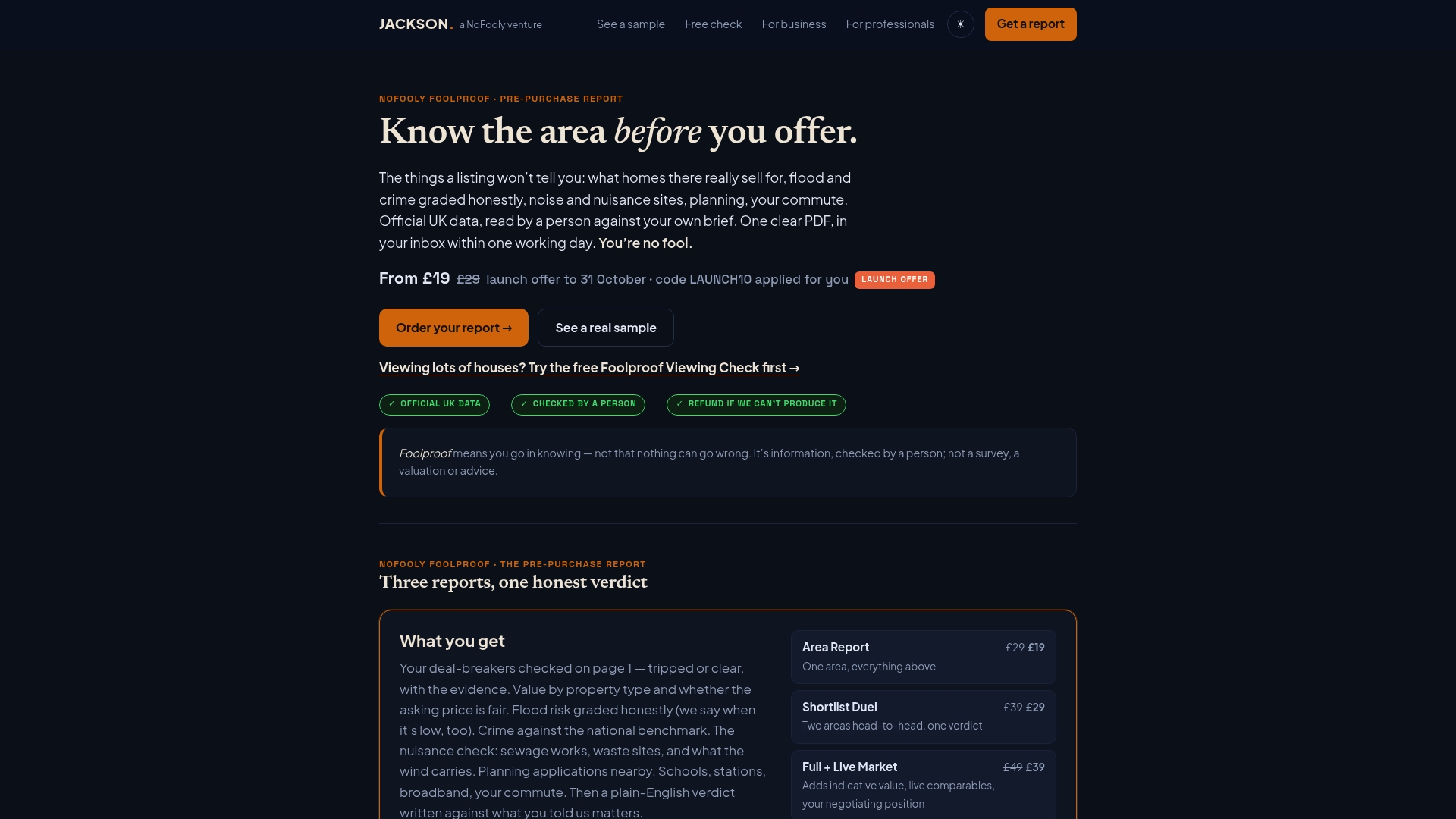
If you have a brief, the Area Report (from £19) is read by a named person against your written deal-breakers, adds the house's sale history and tenure and an indicative, orientation-only read on whether the asking price looks fair against local evidence, and comes back as a PDF within one working day. For comparing two places, the Shortlist Duel puts two areas head to head. Start at NoFooly. Our reports cover England and Wales only, and they are not a survey, legal advice or financial advice.
You can also browse our area guides to see how we present the data, such as Cambridge, Reading and Brentwood, or follow the blog for what changes in area data and what it means.

Who pays for Ofsted, and does it matter?
It is a fair question for anyone wondering how independent the grades are. Ofsted’s 2025 to 2026 annual report says it is funded by Parliament through the Supply Estimates process, with additional income from fees charged to some inspected providers and from charges to other government departments for work done on their behalf. In other words, it is a public body funded through government, not by the schools it grades in the main.
Common mistakes when reading Ofsted ratings
- Treating expected standard as average. Ofsted describes it as a high standard.
- Treating needs attention as a fail. Ofsted says work is required, but it is not a fail.
- Converting old ratings to new ones. Ofsted says the two cannot be compared.
- Trusting a secondhand grade. Listings and websites can lag behind the latest report. Check the Ofsted site.
- Ignoring the date. A snapshot from a past visit may not describe the school today.
- Assuming proximity means a place. Admissions rules decide, not distance alone.
- Applying Ofsted to Wales. Welsh schools are inspected by Estyn.
FAQ
What is the Ofsted rating scale now?
For new school report cards in England, the five grades are exceptional, strong standard, expected standard, needs attention and urgent improvement. Safeguarding is shown separately as met or not met. Each evaluation area, such as curriculum and teaching or attendance and behaviour, receives its own grade.
Is “outstanding” still an Ofsted grade?
Not for schools inspected under the new report cards. Ofsted’s guidance says inspections no longer produce one overall judgement such as outstanding, good or requires improvement. An older report may still show the old judgement until the school is inspected again.
Can I compare a new Ofsted grade with an old one?
No. Ofsted says the new grades cannot be compared with the old ones, because the approach to inspection and the way of reporting are both different. Compare the written findings instead.
Who funds Ofsted?
Ofsted is funded by Parliament through the Supply Estimates process. Its annual report also records income from fees charged to some inspected providers and charges to other government departments.
Does Ofsted inspect schools in Wales?
No. Ofsted works in England. Schools in Wales are inspected by Estyn, the education and training inspectorate for Wales, which publishes its own reports.
Sources
- Understanding Ofsted report cards and grades, GOV.UK
- Ofsted report cards, easy read guide
- Ofsted confirms changes to education inspection and unveils new-look report cards
- Education inspection framework for use from November 2025
- Find an Ofsted inspection report
- What is Ofsted and how does the new school ratings system work?, BBC News
- Ofsted Annual Report and Accounts 2025 to 2026
- Estyn, the education and training inspectorate for Wales
Recommended
Short on time? Let us run the checks for you
Viewing this weekend and don't fancy an afternoon of maps? The free Foolproof Viewing Check pulls the headline tiles for any address you're looking at — no card, no sign-up.
Want the whole area read by hand and written up, checked and signed off by a real person before it reaches you? That's the Jackson pre-purchase area report. Software does the legwork so it's quick and affordable; a person makes the call so you can trust it. Reports start from £19.